What's Your Loomis Home Actually Worth in 2026?
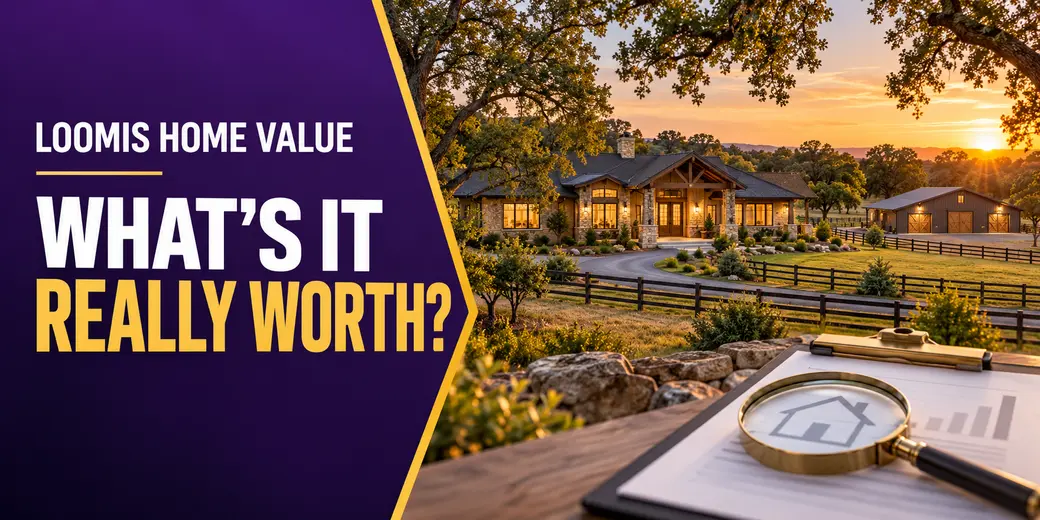
What is my home worth in Loomis, CA?
There is no single reliable number, and that's the honest answer. In 2026, the major valuation sites put the "typical" Loomis home anywhere from roughly $610,000 to $1.6 million depending on which site you open and whether it's measuring sold prices or asking prices. Loomis closes a small number of homes each month, so the averages swing hard and the automated estimates lose accuracy. Pricing a Loomis home takes a hand-built analysis of the handful of genuinely comparable sales — not a Zestimate.
By Rich & Kat Farless | September 11, 2026
Sit down tonight and look up your Loomis address on four different websites. You'll get four different answers, and the spread will be close to a million dollars.
We've watched sellers do exactly this. One site says your home is worth $610,000. Another says $909,000. A third shows a median asking price north of $1.4 million. You're not reading them wrong, and none of them are exactly lying to you. They're measuring different things in a market that is far too small for any of them to measure well.
Here's what's actually going on, and what to do about it before you set a price.
Why the estimates disagree by a million dollars
Three separate problems stack on top of each other in Loomis.
The first is sold versus asking. Redfin's recent median sale price for Loomis has run around $610,000. Zillow's median list price has run around $1.33 million, Homes.com put the August 2026 median list around $1.45 million, and Realtor.com has shown a median listing price near $1.6 million. Those aren't competing estimates of the same thing. Sold prices tell you what closed. List prices tell you what's currently sitting on the market — and in Loomis, what's sitting tends to be the acreage estates that take longest to move. Zillow's own home-value index, which tries to split the difference, has landed somewhere in the $900,000s through 2026.
The second is volume. Loomis is small. In a typical month the town closes single-digit to low-double-digit home sales. When eight or ten homes close in a month, a single 5-acre custom estate or a single 1970s ranch near downtown moves the median by six figures. That's not a trend. That's one house.
You can see the sites straining against this. Pull up Zillow's Loomis market page and several of the metrics sellers care most about — median sale-to-list ratio, median days to pending, percent of sales over list price — come back blank. Not zero. Blank. There isn't enough data to compute them. One competing market write-up for the area says it plainly: limited inventory and few comparable sales make precise median figures less meaningful here than in Roseville or Rocklin.
The third is that automated models are worst at exactly the kind of home Loomis is full of. Zillow publishes its own accuracy numbers: nationally, the median error on off-market homes runs north of 7%, versus roughly 2% for homes actively listed. And that on-market number is flattering, because once you list, the Zestimate pulls toward your list price. It isn't independently confirming your price — it's partly copying it.
For unique properties and homes on acreage, industry analysis puts automated-valuation error rates closer to 15–20%. On a $1.1 million Loomis property, a 17% miss is nearly $190,000. The models are built on dense tracts of similar homes trading often. Loomis is orchards, acreage, custom builds, wildly different lot usability, outbuildings, wells, and septic systems. An algorithm reading public records can't tell a flat, fenced, fully usable 3 acres from 3 acres of slope and native vegetation. A buyer can tell in about ninety seconds.
The appraisal is where a thin market actually costs you
This is the part most Loomis sellers don't see coming, and it's the reason getting the price right matters more here than in a tract neighborhood.
Roughly four out of five GSE purchase loans still go through a traditional appraisal — appraisal waivers ran around 11% of Fannie Mae purchase loans and about 20% of Freddie Mac purchase loans in early 2026. So unless your buyer is paying cash, an appraiser is coming, and they have to find comparable sales.
In Loomis, they often can't find good ones nearby. Fannie Mae's selling guide doesn't actually set a maximum distance for comparables — the "within one mile" rule people repeat is a suburban convention, not policy. For rural and low-density areas, the guide expects appraisers to search wider and explain why the sales they chose are the best available indicators of value. So your appraiser pulls comps from Penryn, Newcastle, Auburn, or Granite Bay, then makes subjective adjustments for acreage, usability, views, outbuildings, and character.
Every one of those adjustments is a judgment call. Stack four or five of them and the number can land well under your contract price.
That's how a Loomis deal falls apart at week five — not because the buyer changed their mind, but because the appraisal came in low and nobody had planned for it. The better move is to price in a way that keeps you out of that conversation entirely.
Two things help. First, price against sales an appraiser will actually be able to use and defend. Second, build the appraisal file for them — a written summary of your property's usable acreage, improvements, permitted structures, well production, septic capacity, and recent upgrades, handed over at the inspection. Appraisers are allowed to consider information you provide. Most sellers never provide any. If you're not sure what's documented on your parcel, our guide to well and septic systems on Loomis properties covers the paperwork that matters.
How to price a Loomis home when the data is thin
Here's the approach we use.
Start with sold, not listed. Active listings tell you what your competition is asking. They tell you nothing about what anyone paid. In a market where estates can sit for three to six months, the active median is heavily weighted toward homes that haven't sold — which is, by definition, the group that got the price wrong.
Widen the geography before you widen the time window. A comparable sale from Penryn or Newcastle six weeks ago is usually more useful than a Loomis sale from fourteen months ago. Markets move; geography adjusts cleanly. Time doesn't.
Adjust for usable acreage, not total acreage. This is the single biggest valuation lever in Loomis and the one every automated model misses. Flat, fenced, irrigated, and accessible land carries real value. Slope, drainage easements, and unbuildable ground carry much less. Two listings at "5 acres" can be worth hundreds of thousands of dollars apart.
Price the improvements the local buyer pool actually wants. Barns, arenas, turnouts, shop space, and functional fencing move money in Loomis because the buyers here are specifically shopping for them — the same features we tell buyers to inspect closely in our guide to buying a horse property in Loomis. Those same improvements would be largely ignored twenty minutes away in a Roseville tract.
Watch the first two weeks like a hawk. Your listing gets its largest audience in days one through seven. If you're getting fewer than three showings in the first fourteen days, the price is the problem, and waiting sixty days to address it is the expensive path. Nationally, roughly a third of sellers ended up cutting their asking price in early 2026, at an average reduction around 7%. Sellers who adjust deliberately in weeks two or three keep their leverage. Sellers who hold out and then cut hard at day ninety usually don't — we broke down that same dynamic for a neighboring market in why Folsom homes aren't selling in 2026.
Know the county backdrop, but don't price to it. Placer County closed 394 homes in August 2026 at a median sold price of $693,000, with an average of 40 days on market and sellers netting about 96% of their original asking price. Inventory sat at 2.9 months — technically still a seller's market, but barely, and buyers have more room to negotiate than they did a year ago. Those numbers are useful context. They are not your number. Loomis behaves nothing like Roseville or Rocklin, which is exactly why the countywide figures mislead here.
The honest summary: in a market this thin, the value of your home isn't something you can look up. It's something that has to be built — sale by sale, adjustment by adjustment, by someone who has actually been inside these properties and knows which three or four transactions in the last six months genuinely tell your story. That's the work, and there's no shortcut around it.
Frequently Asked Questions
Why is my Zestimate so different from my neighbor's price per square foot?
Automated models lean heavily on square footage and public records, which handle tract housing well and acreage poorly. In Loomis, two homes with identical square footage can differ enormously in value based on usable land, outbuildings, well production, and access. Zillow's published error rate on off-market homes runs above 7% nationally and materially higher on unique or acreage properties.
How long does it take to sell a home in Loomis?
It depends heavily on property type. Median days on market in Loomis ran about 46 days in August 2026, but that blends two very different groups — a well-priced standard home near downtown can draw offers within a few weeks, while custom estates on acreage commonly take three to six months. Countywide, Placer averaged 40 days in August 2026.
Should I get a pre-listing appraisal in Loomis?
For an unusual property — significant acreage, substantial outbuildings, a custom build with no close equivalents — it's often worth the few hundred dollars. It surfaces the comparable-sale problem before you're in contract rather than after, and it gives you documentation to hand the buyer's appraiser later. For a conventional home on a standard lot, a well-built market analysis usually does the job.
Can I just price high and come down later?
You can, but it's typically the most expensive strategy available in a low-volume market. Your home draws its largest audience in the first week, and a listing that lingers accumulates days-on-market history that buyers read as a warning sign. In Loomis, where the qualified buyer pool for any given property is already small, burning through it at the wrong price is hard to recover from.
Does the county median tell me anything about my Loomis home?
Very little. Placer County's August 2026 median sold price of $693,000 reflects hundreds of transactions dominated by Roseville, Rocklin, and Lincoln tract housing. Loomis is a different product type at a different price point with a different buyer. Use the county figure for market direction, not for pricing.
If you're thinking about selling in Loomis and you're staring at four different numbers wondering which one to believe, that's the right instinct — none of them are built for a market this size. We'll sit down with you, pull the sales that actually apply to your property, walk through the acreage and improvement adjustments line by line, and give you a real number with the reasoning behind it. If you also want to see the cost side, our breakdown of what it costs to sell a home in Loomis covers commissions, escrow, transfer tax, and net proceeds.
Schedule a free consultation at richandkatsoldthat.com/talktous.
About Rich & Kat Farless
Rich and Kat Farless are a husband-and-wife real estate team with over 30 years of combined experience serving buyers and sellers across the Sacramento region. As the #1 husband-and-wife team in Roseville, CA, they specialize in single family, new construction, and luxury properties across Placer, Sacramento, and El Dorado counties. Connect with them at richandkatsoldthat.com.
Categories
- All Blogs (101)
- Buyer Guides (3)
- Buyers (3)
- Buying a Home (7)
- California Real Estate Process (2)
- First-Time Buyers (2)
- Loomis (1)
- Seller Costs (2)
- Sellers (4)
- Buyer Resources (1)
- buyers (4)
- Buying (4)
- Buying a Home (14)
- Buying a Home, New Construction, Placer County, Roseville (1)
- California Process (1)
- California Real Estate (3)
- California Real Estate Process (12)
- Cost of Buying (2)
- Cost of Homeownership (1)
- Cost to Buy (3)
- Costs & Finances (6)
- El Dorado County (1)
- El Dorado Hills (1)
- Financing & Mortgages (3)
- First-Time Buyers (1)
- Folsom (2)
- Granite Bay (2)
- HOA (1)
- Home Buying (1)
- Home Financing (1)
- Home Prep & Pricing (1)
- Home Selling (3)
- Home Selling Tips (2)
- Lincoln CA (2)
- Loomis (2)
- New Construction (6)
- placer county (1)
- Real Estate Process (1)
- repairs (1)
- Roseville Real Estate (4)
- Seller Costs (2)
- Seller Guides (1)
- Seller Resources (1)
- sellers (3)
- Selling (6)
- selling a home (12)
Recent Posts









Agent License ID: 01193836, 01186753
+1(916) 284-1520 | kat@homesbyrichandkat.com