Buying an Older Home in Folsom, CA: What to Check First
What should you check before buying an older home in Folsom, CA?
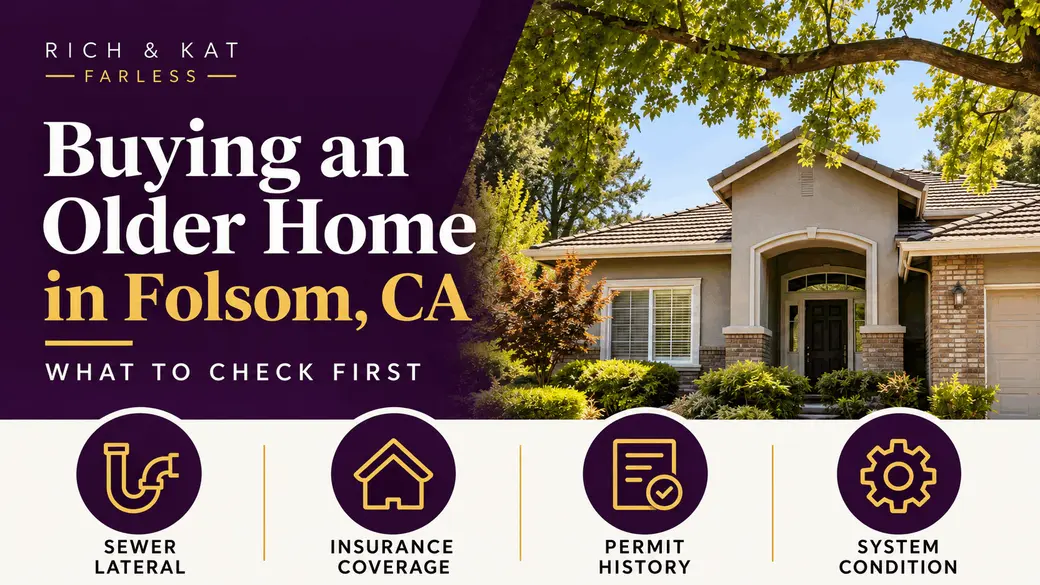
Before you remove contingencies on an older Folsom home, check four things a standard inspection won't fully cover: the sewer lateral (under Folsom Municipal Code Chapter 13.08, the upper lateral from your house to the cleanout is yours, not the city's), whether a carrier will actually insure the roof and electrical panel, the permit history on every visible improvement, and where each major system sits on its replacement clock. Folsom's median home was built in 1997 — roughly two-thirds of the city's housing stock predates 2000 — so this is the default Folsom purchase, not the exception.
By Rich & Kat Farless | September 6, 2026
Most of the buyer content written about Folsom is about Folsom Ranch. That makes sense — it's new, it's marketed hard, and the builders have advertising budgets.
But it isn't where most Folsom homes are.
Folsom has roughly 30,900 housing units, and about 66% of them were built before 2000. The median construction year is 1997. If you're shopping the Folsom resale market in the $600,000 to $1,000,000 range, you're almost certainly looking at a home somewhere between 20 and 40 years old — Natoma Station, Briggs Ranch, Willow Springs, Lexington Hills, American River Canyon, or the older streets closer to Historic Folsom.
That's not a problem. Nationally, the typical home purchased hit a record age of 36 years in 2024, according to Redfin, and a 30-plus-year-old home tends to sell for about 15% less than the overall median. Older homes in Folsom are frequently the better buy — bigger lots, mature trees, established streets, and in most pre-2000 neighborhoods, no Mello-Roos at all.
The problem is that buyers evaluate them wrong. They walk the house, read the inspection report, and negotiate cosmetics. Then they get surprised by something that was never on the report in the first place.
Here's the order we walk our clients through.
Start With the Sewer Lateral — In Folsom, It's Yours
This is the single most expensive thing most Folsom buyers never check.
Folsom's municipal code splits the sewer line in two. The lower lateral — from the cleanout near the property line out to the city main — is the city's. The upper lateral — everything from your house to that cleanout — is the property owner's sole responsibility to inspect, maintain, clear, and repair.
Very few Folsom homeowners know this until something backs up.
And Folsom's older neighborhoods have the exact conditions that break laterals: original cast iron that corrodes from the inside, clay pipe that goes brittle and cracks at the joints, and mature trees whose roots find every one of those joints. A home built in 1988 with a beautiful 35-year-old oak in the front yard is a classic case.
A standard home inspection does not include the sewer line. You have to order a sewer scope separately:
125–500 as a standalone camera inspection
100–250 if you add it to a home inspection you've already scheduled
Add 50–220 if there's no accessible cleanout and the inspector has to pull a toilet
Compare that to what you're buying insurance against:
Cured-in-place lining (trenchless): roughly 80–250 per foot, or about 7,000–15,000 for a typical 50-foot residential lateral
Full replacement: realistically 150–300 per foot all-in once you count permits, shoring, inspection, and putting the driveway, walkway, or landscaping back
Two hundred dollars to avoid a $12,000 surprise is the best money you'll spend in escrow. Order it on day one of your inspection contingency, not day eight — if the scope comes back bad, you want time to get a plumber's bid before your response is due.
This is the same logic we apply to well and septic systems on Loomis properties: specialized systems need specialized inspectors, and the general home inspection isn't one.
Get the Insurance Quote Before You Remove Contingencies
This is the newest failure point, and in 2026 it's the one catching the most buyers off guard.
The California insurance market has tightened hard. The FAIR Plan — the state's insurer of last resort — was carrying 696,562 policies as of June 2026, up about 157% since September 2022, and its rates rise an average of roughly 29.8% statewide on October 15, 2026. Carriers have responded by getting far pickier about what they'll write in the first place.
Two things on an older Folsom home will stop a policy cold.
Roof age. Most California carriers now treat an asphalt shingle roof as too old at 20 to 25 years. Mercury and Wawanesa generally won't insure a roof past 25 years, with exceptions for tile and slate. Even the FAIR Plan won't extend full replacement-cost coverage on a home over 25 years old unless the roof has been replaced inside that window. A 1997 Folsom home on its original or first-replacement roof is squarely in the danger zone. Replacement in the Sacramento market runs about 9,800–15,300 for a 2,000-square-foot asphalt roof, with full jobs commonly landing between $15,000 and $20,000 once tear-off and decking repairs are counted.
The electrical panel. Panels manufactured by Federal Pacific (especially Stab-Lok), Zinsco, Sylvania, Pushmatic, and Challenger have documented histories of breakers that fail to trip. Major carriers writing in California — State Farm, Allstate, USAA, Travelers, Liberty Mutual, and AAA among them — now require replacement before they'll issue or renew. Budget 2,000–6,000 in the Sacramento area for a panel swap and 200-amp upgrade, depending on what the surrounding wiring looks like once it's opened up.
Here's the practical instruction: call an insurance agent with the actual address during your inspection contingency, not after. Give them the roof age, the panel brand, and the year built. If the answer is "we can't write this until the roof is replaced," that's a negotiation you need to be having while you still have the contract right to have it — and it's usually better handled as a credit than a repair. We've written before about why a seller credit and a price reduction aren't the same money, and roof and panel requests are exactly where that math matters.
Price the Replacement Clock, Not the Age
"Is a 30-year-old house too old?" is the wrong question. Condition and maintenance history decide the outcome, not the build year.
The right question is: what has already been replaced, and what hasn't?
Ask the seller — in writing, through the disclosures — for the age and replacement date of each of these. Then price what's left:
Roof: 9,800–20,000 depending on size, pitch, tear-off, and decking
HVAC (full furnace and AC): 9,500–18,000 installed in the Sacramento market. SMUD currently offers up to $3,000 back on qualifying heat pump conversions, which changes the math meaningfully
Water heater: 1,200–3,500 installed, permits included
Whole-house repipe: relevant if the home has polybutylene supply lines, common in the 1980s and prone to joint failure. A California repipe on a 2,000-plus-square-foot home can approach $15,000
Add them up. If a 1994 home in Briggs Ranch has an original roof, a 2006 furnace, and a water heater with a faded label, you're not looking at a $780,000 house — you're looking at a $780,000 house with $30,000 of deferred capital sitting behind the drywall. That's a real number, and it belongs in your offer.
Two Folsom-specific notes:
Foundations. Expansive clay soil is common across the Sacramento region, and post-tensioned slabs were standard in local construction from roughly 1985 to 2005. Seasonal soil movement causes hairline cracking that is usually cosmetic — but differential movement, sticking doors, and sloped floors are not. If your inspector flags anything structural, get a foundation specialist out. Don't negotiate a structural question off a general inspection report.
Mello-Roos, in reverse. This one usually favors you. Most of Folsom's pre-2000 neighborhoods carry no Mello-Roos special tax at all, while 2000s-era districts commonly run about 2,500–5,500 a year, and new construction in Folsom Ranch is widely quoted anywhere from roughly $4,000 to $10,000 a year depending on the district and home size. Sources vary widely on that range, so verify the actual parcel on the tax bill rather than trusting a general figure. Call it $350 a month at the midpoint. At today's rates, $350 a month of avoided tax supports roughly $55,000 of additional loan — and unlike a builder's rate buydown, it never expires. That's the older home's structural advantage, and most buyers never put it on the page next to the repair list.
Check the Permit History — Especially on a Flip
An older home that's been "fully updated" deserves more scrutiny, not less.
Pull the permit history through the City of Folsom's building division before you remove contingencies. You're looking for whether the kitchen remodel, the room addition, the converted garage, the patio cover, the pool equipment, or the panel upgrade were ever permitted. Unpermitted square footage doesn't count toward gross living area in an appraisal, which means you can pay for space the lender won't recognize — and once you own it, the disclosure obligation becomes yours when you sell.
If the seller bought the home recently, California gives you extra protection. Under AB 968 (Civil Code § 1102.6h, effective July 1, 2024), a seller of a single-family home who has owned it less than 18 months must disclose every room addition, structural modification, alteration, and repair made since they took title — and must provide the names and contact information of every contractor paid more than $500, plus copies of any permits pulled.
If a flipped Folsom home comes with a thin disclosure and no contractor list, that's not an oversight. That's a question to ask in writing.
One more thing, because it comes up constantly: if the home sits in the Folsom Historic District overlay, exterior renovations, remodels, and additions on listed or eligible properties go through design review. The City Council streamlined that process in 2025 to allow staff-level approval for minor projects that don't affect designated historic properties, but the review still exists. Know it before you buy the house with plans to change the front elevation.
Frequently Asked Questions
Is it a mistake to buy a 30-year-old home in Folsom instead of new construction?
No — it's the most common Folsom purchase there is, since about two-thirds of the city's housing predates 2000. Older Folsom homes typically offer larger lots, established landscaping, and no Mello-Roos, which can be worth several hundred dollars a month against a new-construction payment. The tradeoff is that you're buying the systems on their existing clock, so price the roof, HVAC, and sewer lateral into your offer rather than assuming they're fine.
Does the City of Folsom pay to fix my sewer line?
Only part of it. Folsom's municipal code makes the city responsible for the lower lateral — the segment from the cleanout near the property line to the main — while the property owner has sole responsibility for the upper lateral running from the house to that cleanout. Since that's the segment most affected by root intrusion and aging cast iron or clay pipe, most sewer repair bills in older Folsom neighborhoods land on the homeowner.
Does Folsom charge a city transfer tax on top of the county's?
No. Folsom is a charter city, which means it legally could impose its own rate, but it charges the standard $0.55 per $1,000 — the same as Roseville, Rocklin, Lincoln, and Loomis. Combined with Sacramento County's 0.55,thetotaldocumentarytransfertaxinFolsomis**1.10 per $1,000** of sale price, or about $865 on a $785,000 home. For contrast, the City of Sacramento adds $2.75 per $1,000 on top of the county rate.
Can I get homeowners insurance on a Folsom home with a 25-year-old roof?
Often not at standard terms. Most California carriers treat an asphalt roof as too old at 20 to 25 years, and several major insurers decline homes past that mark outright. Get a real quote using the property address during your inspection contingency — if coverage requires a new roof, that's a negotiation to have before you remove contingencies, not a discovery to make a week before closing.
How much should I budget for inspections on an older Folsom home?
Plan on 300–1,000 for the general home inspection, plus 100–250 to add a sewer scope, plus whatever specialty inspections the general report triggers — foundation, roof, HVAC, or pest. Spending $600 to $1,200 up front on a $780,000 purchase is proportionate, and on older homes it routinely returns ten or twenty times that in negotiated credits.
The Bottom Line
An older Folsom home isn't a compromise — for a lot of buyers it's the better financial position, especially once you account for the Mello-Roos difference. But it only works if you buy it with your eyes open: scope the lateral, get a real insurance quote, pull the permits, and put a number on every system that's near the end of its life.
That's not a checklist you run alone. The order matters, the timing inside your contingency window matters, and knowing which repair requests actually get answered in this market matters more than either.
If you're weighing an older Folsom home — or trying to decide between a resale on the north side of Highway 50 and something new south of it — Rich & Kat are here to help. Schedule a free consultation at richandkatsoldthat.com/talktous.
About Rich & Kat Farless
Rich and Kat Farless are a husband-and-wife real estate team with over 30 years of combined experience serving buyers and sellers across the Sacramento region. As the #1 husband-and-wife team in Roseville, CA, they specialize in single family, new construction, and luxury properties across Placer, Sacramento, and El Dorado counties. Connect with them at richandkatsoldthat.com.
Categories
- All Blogs (105)
- Buyer Guides (3)
- Buyers (3)
- Buying a Home (9)
- California Real Estate Process (3)
- First-Time Buyers (2)
- Loomis (1)
- Seller Costs (2)
- Sellers (5)
- Buyer Resources (1)
- buyers (4)
- Buying (4)
- Buying a Home (14)
- Buying a Home, New Construction, Placer County, Roseville (1)
- California Process (1)
- California Real Estate (3)
- California Real Estate Process (12)
- Cost of Buying (2)
- Cost of Homeownership (1)
- Cost to Buy (3)
- Costs & Finances (6)
- El Dorado County (1)
- El Dorado Hills (1)
- Financing & Mortgages (3)
- First-Time Buyers (1)
- Folsom (2)
- Granite Bay (2)
- HOA (1)
- Home Buying (1)
- Home Financing (1)
- Home Prep & Pricing (1)
- Home Selling (3)
- Home Selling Tips (2)
- Lincoln CA (2)
- Loomis (2)
- New Construction (6)
- placer county (1)
- Real Estate Process (1)
- repairs (1)
- Roseville Real Estate (4)
- Seller Costs (2)
- Seller Guides (1)
- Seller Resources (1)
- sellers (3)
- Selling (6)
- selling a home (12)
Recent Posts









Agent License ID: 01193836, 01186753
+1(916) 284-1520 | kat@homesbyrichandkat.com