Should You Fix Up Your Roseville Home or Sell As-Is?
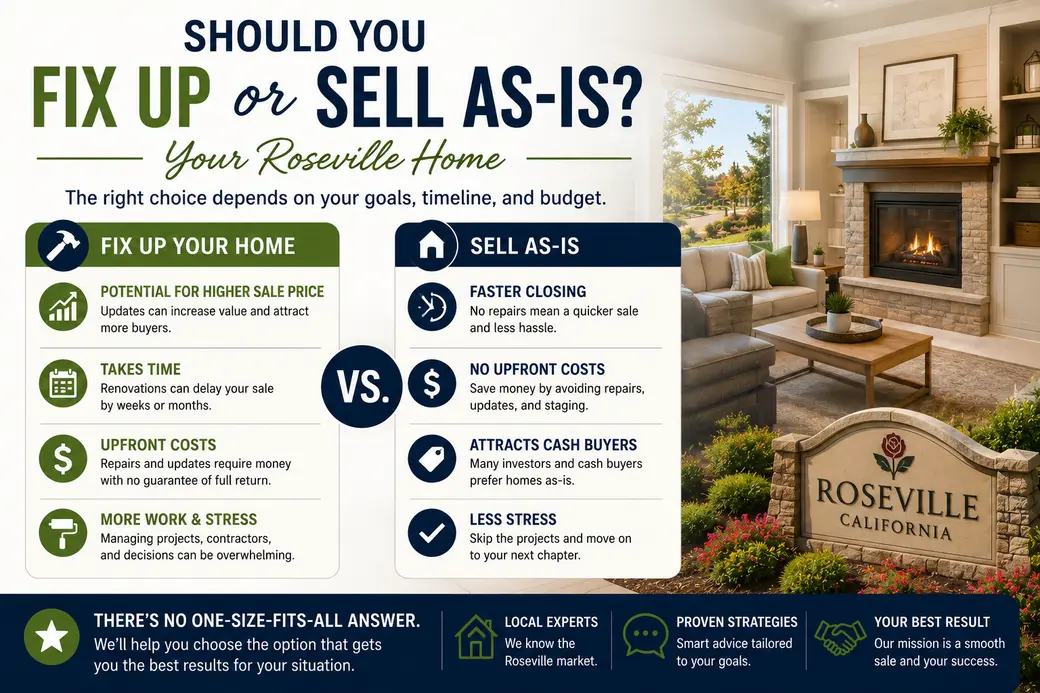
Should you fix up your house or sell it as-is in Roseville?
In Roseville's 2026 market, fix the things that fail inspection and scare buyers off — roof, plumbing, electrical, HVAC, and the three safety items California requires — then sell the rest as-is. Cosmetic updates like fresh interior paint and curb appeal return close to or above their cost, while major kitchen and bath remodels rarely pay for themselves. An as-is home typically sells for 5% to 20% less than a comparable move-in-ready one, so the right move depends on your home's condition, your timeline, and your budget — not a blanket rule.
By Rich & Kat Farless | July 20, 2026
Almost every seller we sit down with asks some version of the same question: Do I need to pour money into this house before I list it, or can I just sell it the way it is?
It's a stressful question, because the wrong answer costs you real money either way. Over-improve, and you sink $40,000 into a kitchen that adds $20,000 to your sale price. Under-prepare, and buyers use every flaw as leverage to chip away at your number after inspection.
Here's how we think about it — and how we've walked hundreds of Placer County sellers through the same decision.
Start With the Market You're Actually Selling Into
The "fix it up or sell as-is" answer changes depending on how hungry buyers are. In a red-hot market, buyers overlook flaws. In a slower one, condition matters a lot more.
Roseville in mid-2026 sits somewhere in between — a selective seller's market that's cooled from the frenzy of a few years ago. As of late spring, the median sale price was hovering around $635,000, homes were selling at roughly 98.7% of asking, and inventory had climbed to about a two-month supply. Well-priced, well-presented homes still move in a few weeks. Homes with obvious problems and an ambitious price sit — and sitting is expensive.
What that means for you: buyers today have a little more room to be picky than they did in 2021. You don't need a perfect house, but you can't ignore the stuff that shows up on an inspection report either. If your home is already in solid shape, light prep and sharp pricing will do the work. If it needs real repairs, you'll want a clear plan before the sign goes in the yard.
This is also why pricing and condition are tied at the hip. If you decide to skip repairs, the price has to reflect that. We walk through exactly how that math works in our guide on whether to lower your asking price in Roseville.
Always Fix the Deal-Killers
Some repairs aren't really optional. These are the issues that either kill a deal outright or hand the buyer a crowbar to pry your price down after they're already in contract:
Roof problems — active leaks, missing shingles, or a roof at the end of its life. This is one of the most common deal-breakers in inspections.
Water damage and plumbing — stains, warping, a musty smell, or old failure-prone piping. Water issues make buyers assume the worst.
Electrical hazards — exposed wiring, frequently tripping breakers, or an outdated panel. Federal Pacific and Zinsco panels in particular get flagged as fire risks and can complicate a buyer's insurance.
HVAC and foundation — a dead furnace or A/C, or any sign of foundation movement, will scare off a big chunk of your buyer pool.
California's required safety items — smoke detectors, carbon monoxide detectors, and water heater strapping are legally required to close. These are cheap. Just handle them.
None of these are glamorous, and none of them make your listing photos prettier. But leaving them undone almost always costs you more at the negotiating table than fixing them would have up front. When a buyer's inspection turns these up mid-escrow, you're negotiating from a position of weakness — which is a very different conversation than the one we cover in negotiating repairs after a home inspection.
Spend on Cosmetics That Actually Pay — Skip the Ones That Don't
Once the functional stuff is handled, the question becomes which cosmetic dollars are worth spending. The data here is remarkably consistent, and it's not the big remodels that win.
The high-return moves — usually worth it:
Fresh interior paint in warm, neutral tones. Repainting the interior of a 1,500-square-foot Roseville home runs around $3,000 professionally and often adds $4,000 to $6,000 in perceived value — roughly a 100%+ return. It's the single best dollar most sellers can spend.
Curb appeal — clean landscaping, fresh mulch, a tidy front entry. Exterior first impressions drive offers, and simple yard work returns well above its cost.
A new or freshly painted garage door and front door. These small exterior swaps consistently land near the top of every cost-versus-value study.
Light fixes and deep cleaning — patched nail holes, working outlets, a spotless kitchen and bathrooms.
The low-return moves — usually skip:
Major kitchen or bath remodels. A full kitchen renovation can run $40,000 to $80,000 and typically returns under 50% at resale. If your kitchen works but looks dated, price for it and let the buyer remodel to their own taste.
Window and door replacement. Expensive, and rarely recouped unless the existing ones are broken.
Pools, room additions, and anything that over-improves your home relative to the neighborhood. A remodel that pushes your home well above comparable Roseville sales won't get paid back.
One 2026 wrinkle worth knowing: federal tariffs added roughly 25% to the cost of cabinets and vanities and about 10% to softwood lumber. Kitchen and outdoor projects cost more this year than they did a couple of years ago, which tilts the math even further toward "skip the big remodel."
The rule we give every seller: fix what fails, refresh what's cheap, and don't remodel for the next owner.
What Selling As-Is Really Means in California
"As-is" gets misunderstood a lot, so let's be precise. Selling as-is means you're telling buyers up front that you won't be making repairs after their inspection. It does not mean you can hide problems.
California sellers still have to disclose every known material defect, no matter what condition they're selling in. The Transfer Disclosure Statement, the Seller Property Questionnaire, and the Natural Hazard Disclosure all still apply. If you know the roof leaks, you have to say so — as-is or not. We break down exactly what that covers in our guide to California seller disclosure requirements.
This is where a lot of sellers get tripped up by pre-listing inspections. Paying $400 for your own inspection before you list can help you price accurately and head off surprises — but the moment that report exists, everything in it becomes something you're legally obligated to disclose. That's not a reason to avoid one; it's a reason to go in with eyes open and a strategy.
Selling as-is is often the right call when the home needs tens of thousands in work with uncertain payback, when you've inherited a property you're not attached to, or when speed matters more than squeezing out the last dollar. Just know the trade-off: as-is homes generally sell for 5% to 20% below comparable move-in-ready homes. On a $635,000 Roseville home, that's a swing of roughly $32,000 to $127,000 — which is exactly why this decision deserves real analysis, not a coin flip.
So How Do You Decide?
Run your home through three quick filters:
Condition — Are there deal-killers (roof, systems, foundation, safety)? Those get fixed regardless. Everything else is negotiable.
Timeline — Selling fast because of a job move, a probate situation, or a home you're carrying two payments on? Lean toward light prep and an as-is-friendly price. Time to do it right? Invest in the cheap, high-return refreshes.
Budget — Repairs cost money up front with no guaranteed dollar-for-dollar return. If cash is tight, prioritize the deal-killers and the paint, and price honestly for the rest.
Your net number at the end depends on all three of these working together — the repairs you make, the price you set, and the costs of selling. If you want to see how the prep decision flows into your bottom line, our breakdown of what it costs to sell a home in Roseville shows where the money actually goes.
Frequently Asked Questions
Do I have to disclose problems if I sell my house as-is in California?
Yes. Selling as-is only means you won't make repairs after the buyer's inspection — it does not waive your disclosure duties. California sellers must still complete the Transfer Disclosure Statement, Seller Property Questionnaire, and Natural Hazard Disclosure, and disclose every known material defect regardless of the home's condition.
How much less does an as-is home sell for in Roseville?
As-is homes typically sell for 5% to 20% less than comparable move-in-ready homes, depending on condition and how strong the market is. In a balanced market like Roseville in 2026, the discount tends to land in the middle of that range, but a well-priced as-is home in a desirable area can see a much smaller gap.
What repairs are actually required to sell a home in California?
Very few. California legally requires working smoke detectors, carbon monoxide detectors, and water heater strapping. Beyond those safety items, no repairs are mandatory — but leaving major functional problems unaddressed usually costs you more in buyer negotiations than fixing them would have.
Is it worth painting the interior before selling?
In most cases, yes. Fresh, neutral interior paint is one of the highest-return improvements a seller can make — often returning at or above 100% of its cost — and it makes a home show brighter and better maintained in photos and showings. It's usually the first dollar we'd spend.
Should I get a pre-listing inspection before selling my Roseville home?
It can be smart for older homes, because it lets you fix or price around issues before a buyer finds them. Just remember that anything the inspection reveals becomes a defect you're legally required to disclose in California, so it's a strategic decision worth talking through with your agent first.
The Bottom Line
You don't need to renovate your Roseville home to sell it well — you need to fix what fails, refresh what's cheap, and price honestly for everything else. The sellers who net the most aren't the ones who spend the most on repairs. They're the ones who spend strategically and price to match.
Every home and every situation is different, and the only way to know the right move for yours is to walk the property and run the numbers with someone who knows this market. That's exactly what we do before we ever recommend listing.
If you're ready to talk through your situation — whether you're getting a home ready to sell, weighing an as-is sale, or just figuring out your next move — Rich & Kat are here to help. Schedule a free consultation at richandkatsoldthat.com/talktous.
About Rich & Kat Farless
Rich and Kat Farless are a husband-and-wife real estate team with over 30 years of combined experience serving buyers and sellers across the Sacramento region. As the #1 husband-and-wife team in Roseville, CA, they specialize in single family, new construction, and luxury properties across Placer, Sacramento, and El Dorado counties. Connect with them at richandkatsoldthat.com.
Categories
- All Blogs (73)
- Buyer Guides (2)
- Buyers (1)
- Buying a Home (6)
- First-Time Buyers (2)
- Sellers (2)
- Buyer Resources (1)
- buyers (4)
- Buying (4)
- Buying a Home (14)
- Buying a Home, New Construction, Placer County, Roseville (1)
- California Process (1)
- California Real Estate (2)
- California Real Estate Process (10)
- Cost of Buying (2)
- Cost to Buy (2)
- Costs & Finances (5)
- El Dorado County (1)
- El Dorado Hills (1)
- Financing & Mortgages (3)
- First-Time Buyers (1)
- Folsom (2)
- Granite Bay (1)
- HOA (1)
- Home Buying (1)
- Home Financing (1)
- Home Prep & Pricing (1)
- Home Selling (3)
- Home Selling Tips (2)
- Lincoln CA (1)
- Loomis (2)
- New Construction (5)
- placer county (1)
- Real Estate Process (1)
- repairs (1)
- Roseville Real Estate (4)
- Seller Costs (2)
- Seller Resources (1)
- sellers (3)
- Selling (4)
- selling a home (11)
Recent Posts









Agent License ID: 01193836, 01186753
+1(916) 284-1520 | kat@homesbyrichandkat.com