Mello-Roos in Folsom, CA: What It Does to Your Budget
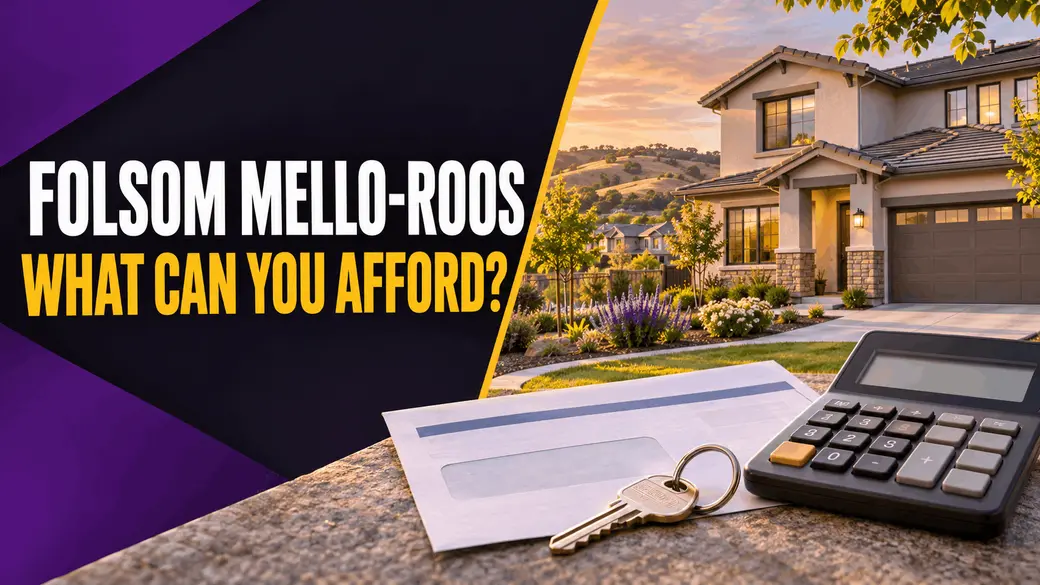
How does Mello-Roos affect what you can afford in Folsom, CA?
Mello-Roos is a special tax on top of your regular property tax, and lenders count it as part of your monthly housing payment. In newer Folsom communities, it can run roughly $200 to $500 a month, which at today's 7.03% mortgage rate can shrink the loan you qualify for by about $30,000 to $75,000. The exact amount is set parcel by parcel, so you need the property's actual special tax notice before you write an offer.
By Rich & Kat Farless | September 28, 2026
Mortgage rates just crossed 7% for the first time since January 2025. That makes every dollar of monthly cost matter more than it did a month ago — and Mello-Roos is the line item Folsom buyers most often discover too late.
If you've looked at Folsom Ranch or any newer Folsom community, you've probably seen a listing where the price looks fine and the tax bill doesn't. Here's how the tax works, what it does to your buying power, and how to verify the real number before you're committed.
What Mello-Roos Actually Is (and Isn't) in Folsom
Mello-Roos is a special tax created by a Community Facilities District (CFD). Developers use CFD bonds to pay for roads, parks, utilities, and other infrastructure in new communities, and the homeowners in that district repay those bonds through an annual special tax on their property tax bill.
Three things trip buyers up:
It's additional. Sacramento County's base property tax rate is about 1% of assessed value. Mello-Roos is added on top of that, along with any other voter-approved bonds and assessments.
It's parcel-specific. Two homes on the same street can carry different amounts, depending on lot size, home size, and how the district classifies each parcel.
It follows the property. When you buy, you take over the remaining payments. It isn't a balance you can usually pay off at closing. We covered the exceptions in our post on whether you can pay off Mello-Roos early in Roseville — the same principles apply in Folsom.
Not every Folsom home has it. Many established neighborhoods have little or no special tax, while newer master-planned areas — Folsom Ranch is the big one — commonly do. Local sources put Folsom Ranch special taxes in the neighborhood of $300 to $500 a month, and older Folsom subdivisions have been reported in the low thousands per year. Treat those as ranges, not quotes. The only number that matters is the one attached to the parcel you're buying.
The 7% Problem: What Mello-Roos Does to Your Buying Power
Lenders treat Mello-Roos like property tax. It goes into your monthly housing payment when they calculate your debt-to-income ratio, which means every dollar of special tax uses up a dollar of the payment you're approved for.
Here's the math at this week's Freddie Mac rate of 7.03% on a 30-year fixed loan. Every $1,000 of loan costs about $6.67 a month in principal and interest, so:
$200/month of Mello-Roos (about 2,400ayear)takesroughly**30,000** off the loan you can qualify for
$300/month (about 3,600ayear)takesroughly**45,000** off
$417/month (about 5,000ayear)takesroughly**62,500** off
Those are illustrative numbers based on principal and interest only. Your real qualifying picture depends on your income, other debts, credit, down payment, and loan program. But the pattern holds: a Mello-Roos bill isn't a rounding error. At 7%, it can be the difference between the $850,000 home you're shopping and the $790,000 home you actually qualify for.
This is why we ask every Folsom buyer the same question up front: what's your comfortable total monthly payment? Work backward from that number. Don't start from the list price.
Why Mello-Roos Can Change the Value Comparison
A lower price on a Mello-Roos home isn't automatically a better deal than a higher price on a home without one. Run the comparison on total monthly cost.
Say you're choosing between two Folsom homes:
Home A: $800,000, no special tax
Home B: $770,000, with $4,200 a year (about $350/month) in Mello-Roos
Home B looks $30,000 cheaper. But that $350 a month is roughly what a $52,000 loan costs at 7.03% — so on a monthly basis, Home B can cost more than Home A even with the lower price. New-construction builders know this, which is why you'll often see incentives, rate buydowns, or closing credits around communities with higher special taxes. We break down how to weigh those offers in our guide to Folsom Ranch new construction and builder incentives.
Two more things to weigh:
Duration. Many CFDs run 30 to 40 years, though the term depends on the district's formation documents and bond schedule. Ask when the bonds mature. A tax that ends in 12 years is a very different cost than one that lasts 30.
Escalators. Some special taxes include annual escalators, so the number on today's bill may not be next decade's.
How to Verify the Real Number Before You Make an Offer
Don't rely on a listing, a builder's brochure, or a blog post (including this one). Here's the checklist we run for buyers:
Get the APN. The Assessor's Parcel Number is on the listing or the current tax bill.
Pull the Sacramento County tax bill for that APN and look for lines labeled "CFD," "Community Facilities District," or a district name.
Ask for the Notice of Special Tax. California law (Civil Code §1102.6b) requires sellers to make a good-faith effort to get this notice from each CFD and deliver it to you. It should show the district name, the annual amount, and how long it lasts. Ask for it early — ideally before you write an offer.
Check for more than one district. Some parcels sit in overlapping districts, each with its own tax.
Read the preliminary title report. Special assessments show up on it, and it's your cross-check against what the seller told you.
Send the full tax bill to your lender before you lock your rate. Surprises at underwriting delay closings and can change your approval.
For a deeper look at how CFDs work across our markets, our Mello-Roos guide for Roseville buyers walks through the basics.
What This Means for Your Folsom Home Search
Mello-Roos isn't a reason to skip a home. Plenty of buyers choose newer Folsom communities and are happy with the tradeoffs — newer construction, modern floor plans, and amenities that come with those districts. The point is to choose it knowingly.
If you're comparing Folsom neighborhoods, start with the total monthly cost of each home you're considering, not the price. Our breakdown of what it costs to buy a home in Folsom is a good starting point for the other line items — closing costs, insurance, and property tax.
Every buyer's situation is different, and Mello-Roos math changes with your loan program, down payment, and rate. If you'd like us to run the numbers on the specific Folsom homes you're considering — including the special tax — we'll do it before you spend a dime on an offer.
Frequently Asked Questions
Does every home in Folsom have Mello-Roos?
No. Many established Folsom neighborhoods have little or no special tax, while newer master-planned communities like Folsom Ranch commonly do. It's assigned parcel by parcel, so two nearby homes can differ. Check the tax bill for the specific APN and ask the seller for the Notice of Special Tax.
How much is Mello-Roos in Folsom Ranch?
Local sources put Folsom Ranch special taxes around $300 to $500 a month on top of standard property tax, but the amount varies by village, builder, lot, and home size. Don't budget from a range. Ask the builder or seller for the exact figure on the parcel you're buying, in writing.
Do lenders count Mello-Roos when qualifying me for a mortgage?
Yes. Lenders treat Mello-Roos like property tax and include it in your monthly housing payment when calculating debt-to-income ratio. At a 7% rate, each $100 a month of special tax reduces your loan capacity by roughly $15,000. Give your lender the full tax bill before you lock your rate.
Can I pay off Mello-Roos when I buy a home in Folsom?
Usually not as a simple payoff. Most CFDs are tied to outstanding bonds, so the tax continues until the bonds are paid or the district ends it. Some districts allow prepayment under specific terms, so ask the CFD administrator and your lender before assuming either way.
How long does Mello-Roos last?
It depends on the district's formation documents and bond schedule. Many run 20 to 40 years. The Notice of Special Tax and the CFD's own documents should show when it ends and whether it escalates each year.
Ready to Run the Numbers on a Folsom Home?
Mello-Roos is one of the easiest costs to check and one of the most expensive to miss. If you're looking at Folsom homes — new construction or resale — we'll pull the special tax, model your real monthly payment at today's rates, and show you what each home actually costs to own.
Schedule a free consultation at richandkatsoldthat.com/talktous.
Rich and Kat Farless are a husband-and-wife real estate team with over 30 years of combined experience serving buyers and sellers across the Sacramento region. As the #1 husband-and-wife team in Roseville, CA, they specialize in single family, new construction, and luxury properties across Placer, Sacramento, and El Dorado counties. Connect with them at richandkatsoldthat.com.
This post is general information, not tax, legal, or lending advice. Confirm figures with your lender and the applicable CFD.
Categories
- All Blogs (114)
- Buyer Guides (4)
- Buyers (4)
- Buying a Home (11)
- California Real Estate Process (4)
- First-Time Buyers (2)
- Investors & Rentals (1)
- Loomis (1)
- Seller Costs (2)
- Sellers (6)
- Selling (1)
- Buyer Resources (1)
- buyers (4)
- Buying (4)
- Buying a Home (14)
- Buying a Home, New Construction, Placer County, Roseville (1)
- California Process (1)
- California Real Estate (3)
- California Real Estate Process (12)
- Cost of Buying (2)
- Cost of Homeownership (1)
- Cost to Buy (3)
- Costs & Finances (6)
- El Dorado County (1)
- El Dorado Hills (1)
- Financing & Mortgages (3)
- First-Time Buyers (1)
- Folsom (3)
- Granite Bay (3)
- HOA (1)
- Home Buying (1)
- Home Financing (1)
- Home Prep & Pricing (1)
- Home Selling (3)
- Home Selling Tips (2)
- Lincoln CA (2)
- Loomis (2)
- New Construction (8)
- placer county (1)
- Real Estate Process (1)
- repairs (1)
- Roseville (2)
- Roseville Real Estate (4)
- Seller Costs (2)
- Seller Guides (1)
- Seller Resources (1)
- sellers (3)
- Selling (6)
- selling a home (12)
Recent Posts







Agent License ID: 01193836, 01186753
+1(916) 284-1520 | kat@homesbyrichandkat.com