Folsom vs. El Dorado Hills: Which Costs Less in 2026?
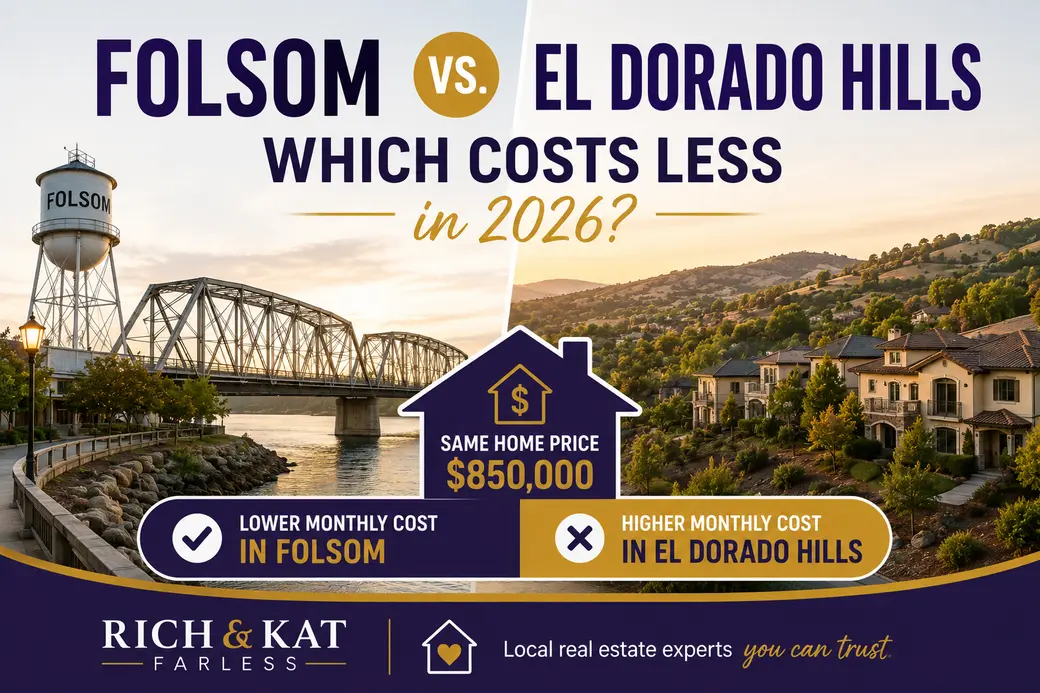
Is it cheaper to buy a home in Folsom or El Dorado Hills?
Folsom is the cheaper city to own in for most buyers in 2026 — not because of the sticker price, but because of what comes after closing. Two identical $850,000 homes six miles apart can differ by $750–$800 a month once you add up property taxes, Mello-Roos, wildfire insurance, HOA dues, and the SMUD-versus-PG&E electric bill. Folsom's median sale price sits near $769,000 versus roughly $870,000–$907,000 in El Dorado Hills, but El Dorado Hills gives you more lot, more inventory, and more room to negotiate.
By Rich & Kat Farless | August 14, 2026
Folsom and El Dorado Hills sit about six miles apart across the county line, and we get this question constantly — from buyers relocating into the Sacramento region, and from Placer County move-up buyers deciding whether to cross Highway 50 instead of staying north.
Here's the short version of what we tell them: stop comparing list prices and start comparing the monthly number on the specific parcel.
The two cities are close enough that the price gap — about $100,000 at the median — is often the smallest difference between them. The carrying costs are where the real money is, and they don't split neatly by city. They split by neighborhood, by tax district, and by fire zone.
The Real Cost Gap: Same Price, Different Monthly Payment
Let's take the emotion out of it and run the same house twice.
Assume an $850,000 purchase with 20% down ($170,000 down, a $680,000 loan). At roughly 6.5% on a 30-year fixed, principal and interest lands near $4,298 a month in both cities. That loan is comfortably under the 2026 conforming limit of $832,750, which applies in Sacramento, Placer, and El Dorado counties alike.
So the mortgage is a wash. Everything else isn't.
Established Folsom home (Broadstone-era, no active CFD):
Principal and interest: $4,298
Property taxes at roughly 1.15% effective: ~$815
Homeowners insurance (valley floor): ~$135
Mello-Roos: $0
HOA: ~$75
Electric (SMUD): ~$150
Monthly total: roughly $5,473
El Dorado Hills master-planned village (active CFD, foothill fire zone):
Principal and interest: $4,298
Property taxes at roughly 1.1% base: ~$779
Mello-Roos / CFD special tax: ~$300
Homeowners insurance (foothill): ~$450
HOA: ~$210
Electric (PG&E): ~$215
Monthly total: roughly $6,252
That's a $779 monthly gap — about $9,350 a year — on the identical purchase price. Over ten years, before you account for a single rate change, that's north of $90,000.
Three line items drive almost all of it, and each one is worth understanding before you write an offer.
Mello-Roos isn't a Folsom problem or an El Dorado Hills problem
It's a parcel problem, and it cuts both directions.
In El Dorado Hills, the master-planned communities — Serrano, Blackstone, The Promontory — almost always carry an active Community Facilities District. Depending on the village, that runs $200 to $500-plus a month on top of your base property tax. Some El Dorado Hills homes push the effective tax rate to 1.5%–1.8%.
But Folsom is not automatically clean. Folsom Ranch and parts of Empire Ranch carry active CFDs in the $300–$500 monthly range — those bonds were issued recently and have decades left to run. Meanwhile, Folsom's established neighborhoods like Broadstone and Willow Creek were bonded in the early-to-mid 1990s. Thirty years of payments later, those parcels often carry $800–$3,000 a year, and some carry nothing at all.
So a Folsom Ranch buyer and an established El Dorado Hills buyer can end up with the gap reversed. If you want the full mechanics, we broke this down in our guide to how Mello-Roos affects your real monthly payment.
The only reliable way to know is to pull the actual tax bill for the specific parcel and read the Notice of Special Tax. We do this before our clients remove contingencies — never after.
Wildfire insurance is the biggest swing item
This is the line that shocks people, and it's the one most buyers don't price until they're already in escrow.
A home on the Folsom valley floor commonly insures for $1,200–$2,000 a year. A comparable home in the higher elevations of El Dorado Hills can run $4,000–$8,000 a year, and homes deep in a High or Very High Fire Hazard Severity Zone can go past $10,000 — assuming a standard carrier will write it at all. When they won't, you're looking at the California FAIR Plan plus a wraparound policy, which costs more and covers less.
That's a $300–$500 monthly difference hiding inside a number most buyers treat as a rounding error. Our homeowners insurance guide for Sacramento-area buyers walks through how to get a bindable quote early.
Get a written quote on the specific address before your inspection contingency expires. Not a ballpark. Not last year's premium from the seller. A quote in your name.
The utility line nobody budgets for
Folsom is inside the SMUD service territory. El Dorado Hills is PG&E.
SMUD's residential rates run roughly $0.14–$0.17 per kilowatt-hour and sit among the lowest in California — meaningfully below PG&E for a comparable bill. In practical terms, a household spending $150 a month on electricity in Folsom would commonly spend $200–$225 for the same usage in El Dorado Hills.
Call it $600–$900 a year. It won't decide your purchase, but over a decade of ownership in a valley climate with real summer cooling load, it's a car.
What El Dorado Hills Gives You Back
If the math above were the whole story, nobody would buy in El Dorado Hills — and plenty of very smart buyers do. Here's the other side.
More room to negotiate. Folsom in mid-2026 is fast: a median of about 13 days on market and roughly 2.2 offers per home. That's a seller's market, and it means less leverage on price, credits, and repairs. El Dorado Hills is running 45–63 days on market with about 97 active listings — a slower, more balanced market where a well-prepared buyer can actually negotiate.
More house and more lot per dollar in the upper tier. El Dorado Hills homes generally run larger with bigger parcels and foothill views. If your search is in the $900,000–$1.5M range, the product mix there is deeper.
Watch the jumbo line if you go up-market. At 20% down, you cross the $832,750 conforming limit at roughly a $1,040,000 purchase price. Folsom's median doesn't get near it. A good chunk of El Dorado Hills' inventory does — and jumbo financing means tighter reserve requirements and a different underwriting conversation. That's a lender call to make before you fall in love with a house.
Folsom's counterweight is access and growth. Folsom's mean commute runs about 26.6 minutes versus roughly 32 in El Dorado Hills, and Folsom has light rail — the Historic Folsom, Iron Point, and Glenn stations connect to downtown Sacramento in about 55–65 minutes. El Dorado Hills has no rail equivalent; El Dorado Transit's 50 Express runs riders to the Iron Point station. On the growth side, Folsom Ranch is a 25-to-30-year buildout of roughly 11,000 homes and up to 8,000 jobs, and its Southpointe commercial center broke ground in July 2026.
One more seller-side note. Folsom is a charter city and levies its own documentary transfer tax on top of Sacramento County's $1.10 per $1,000. El Dorado Hills is unincorporated El Dorado County — county transfer tax only, no city add-on. It's a few hundred dollars, but it shows up on your closing statement the day you sell.
If you want the full line-item picture for either market, we've published a complete cost-to-buy breakdown for Folsom and a matching one for El Dorado Hills.
How to Actually Decide
Don't decide between two cities. Decide between two addresses.
Here's the checklist we run with clients comparing across the Highway 50 line:
Pull the current tax bill on each specific parcel. Look for the Mello-Roos line and the remaining bond term — not just this year's amount.
Get a written insurance quote on each address before contingencies expire. Ask whether the carrier will write it at all.
Run both as a full monthly number — principal, interest, taxes, special taxes, insurance, HOA, and electric. Not just P&I.
Check the jumbo threshold with your lender if either home is above roughly $1,040,000 at your down payment.
Price the market you're buying into. A 13-day market and a 60-day market require completely different offer strategies.
Do those five things and the answer usually stops being a debate. One address is $600 a month cheaper to carry, or it isn't — and now you know which.
That comparison takes us about twenty minutes per property, and it's the single most useful thing we do for buyers deciding between these two markets.
Frequently Asked Questions
Is El Dorado Hills more expensive than Folsom?
Yes, on both fronts. El Dorado Hills' median sale price runs roughly $870,000–$907,000 in 2026 versus about $769,000 in Folsom, and monthly carrying costs are typically higher because of foothill wildfire insurance, PG&E rates, and active Mello-Roos districts in most master-planned villages. The gap on an identical $850,000 purchase commonly lands near $750–$800 a month.
Does Folsom have Mello-Roos?
Some of it does. Folsom Ranch and parts of Empire Ranch carry active Community Facilities Districts running roughly $300–$500 a month, while established neighborhoods like Broadstone and Willow Creek — bonded in the early-to-mid 1990s — often carry $800–$3,000 a year or nothing at all. Always verify on the specific parcel's tax bill rather than assuming by neighborhood.
Why is homeowners insurance so much higher in El Dorado Hills?
Much of El Dorado Hills sits in the foothills within High or Very High Fire Hazard Severity Zones, which pushes premiums to roughly $4,000–$8,000 a year versus $1,200–$2,000 on the Folsom valley floor. In the highest-risk pockets, standard carriers may decline coverage entirely, leaving the California FAIR Plan plus a difference-in-conditions policy as the fallback.
Which market is easier to buy in right now?
El Dorado Hills. Homes there are averaging 45–63 days on market with roughly 97 active listings, while Folsom is moving at a median of about 13 days with an average of 2.2 offers per home. More days on market and more inventory generally translate to more negotiating leverage on price, credits, and repairs.
Do I need a jumbo loan to buy in El Dorado Hills?
Not always, but often in the upper tier. The 2026 conforming limit is $832,750 in Sacramento, Placer, and El Dorado counties, and at 20% down you cross it at roughly a $1,040,000 purchase price. Talk to your lender before you shop — jumbo underwriting brings tighter reserve requirements and a different qualifying conversation.
Which One Is Right for You?
Folsom generally wins on total cost of ownership. El Dorado Hills generally wins on lot size, inventory, and negotiating room. But the city-level answer is almost never the answer that matters — the parcel-level answer is, and it can flip the whole comparison in either direction.
We run this exact analysis for buyers every week across Folsom, El Dorado Hills, Roseville, Granite Bay, Lincoln, and Loomis. Bring us two addresses and we'll show you what each one actually costs to own, line by line, before you write an offer.
If you're ready to talk through your situation — whether you're buying, selling, or just figuring out your next move — Rich & Kat are here to help. Schedule a free consultation at richandkatsoldthat.com/talktous.
About Rich & Kat Farless
Rich and Kat Farless are a husband-and-wife real estate team with over 30 years of combined experience serving buyers and sellers across the Sacramento region. As the #1 husband-and-wife team in Roseville, CA, they specialize in single family, new construction, and luxury properties across Placer, Sacramento, and El Dorado counties. Connect with them at richandkatsoldthat.com.
Cost figures are 2026 ranges for illustration and vary by parcel, lot, carrier, and lender. Mello-Roos amounts, property tax rates, and insurance premiums must be verified on the specific property. We're not lenders, tax professionals, or insurance agents — confirm loan terms with your lender, tax questions with a CPA, and coverage with a licensed insurance broker.
Categories
- All Blogs (78)
- Buyer Guides (3)
- Buyers (1)
- Buying a Home (7)
- First-Time Buyers (2)
- Sellers (2)
- Buyer Resources (1)
- buyers (4)
- Buying (4)
- Buying a Home (14)
- Buying a Home, New Construction, Placer County, Roseville (1)
- California Process (1)
- California Real Estate (2)
- California Real Estate Process (10)
- Cost of Buying (2)
- Cost of Homeownership (1)
- Cost to Buy (2)
- Costs & Finances (6)
- El Dorado County (1)
- El Dorado Hills (1)
- Financing & Mortgages (3)
- First-Time Buyers (1)
- Folsom (2)
- Granite Bay (1)
- HOA (1)
- Home Buying (1)
- Home Financing (1)
- Home Prep & Pricing (1)
- Home Selling (3)
- Home Selling Tips (2)
- Lincoln CA (1)
- Loomis (2)
- New Construction (5)
- placer county (1)
- Real Estate Process (1)
- repairs (1)
- Roseville Real Estate (4)
- Seller Costs (2)
- Seller Guides (1)
- Seller Resources (1)
- sellers (3)
- Selling (4)
- selling a home (11)
Recent Posts



Agent License ID: 01193836, 01186753
+1(916) 284-1520 | kat@homesbyrichandkat.com