Quick Move-In or Build to Order in El Dorado Hills?
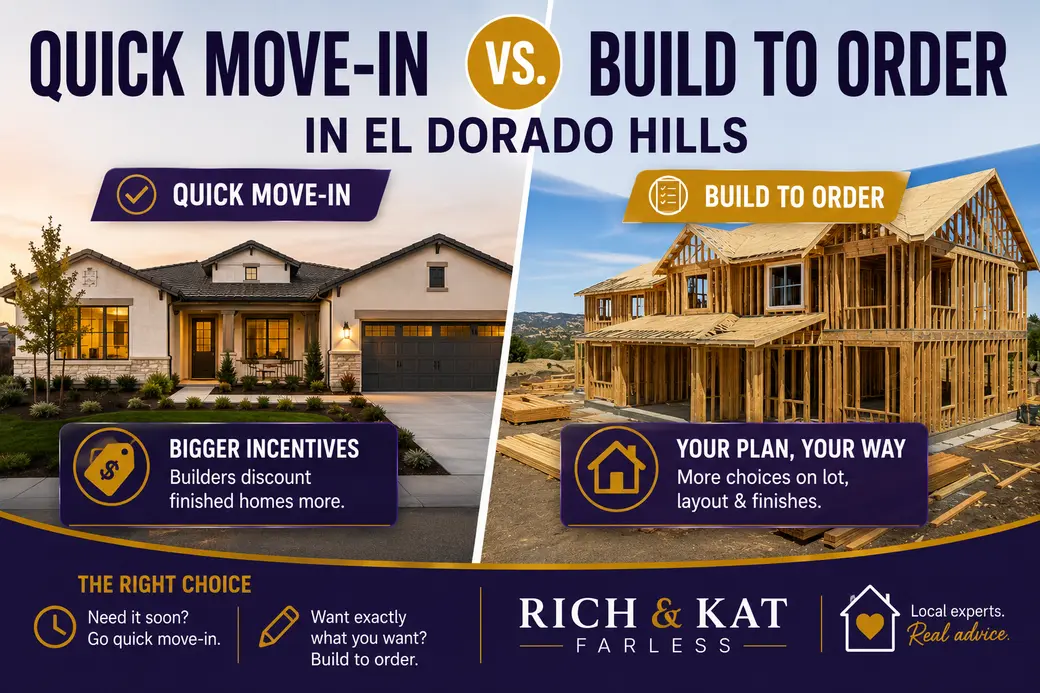
Should you buy a quick move-in home or build to order in El Dorado Hills?
In 2026, quick move-in homes carry the bigger builder incentives — nationally, builders discount finished inventory harder than homes that haven't broken ground, because every month a completed house sits, it costs them money. But in El Dorado Hills specifically, most of the true quick move-in inventory right now sits inside age-restricted communities, and the deepest discounts on non-age-restricted homes are across the county line in Folsom, Rocklin, and Bickford Ranch. Build to order if you need a specific lot, a specific plan, or you're not in a hurry. Buy the finished home if you want the incentive and the certainty.
By Rich & Kat Farless | September 16, 2026
Most articles on this question tell you it's a trade between customization and speed. That's not wrong, but it's not the decision you're actually making in this market.
The real question in El Dorado Hills in 2026 is who absorbs the risk — you or the builder. And the answer changes the moment you understand where the incentive money is actually attached.
The incentive follows the house, not you
Here's the part that surprises almost every buyer we walk into a sales office: the builder's best offer usually isn't a company-wide promotion. It's attached to specific addresses.
Builders don't like cutting base prices, because a price cut on one home resets the comp for every remaining home in the community. Buying down your rate or covering your closing costs does the same thing for your monthly payment without touching the price sheet. So the money flows to the homes the builder most needs off the books — the finished ones.
The national data backs that up. According to NAHB, 63% of builders used sales incentives in both July and August 2026 — the sixteenth straight month at 60% or higher. Roughly 35–37% cut prices outright, at an average reduction of about 6%. And in recent surveys of new-home communities, a noticeably larger share offered incentives on quick move-in homes than on to-be-built homes.
You can watch this play out locally. Toll Brothers ran a Quick Move-In Sales Event from August 8–23, 2026 across its Sacramento-area communities, advertising a 3.99% first-year rate (6.04% APR) on a 30-year fixed with a 2/1 buydown. Read the offer carefully and you'll notice what it applies to: quick move-in homes. If you sign a to-be-built contract, you don't get it.
The clearest illustration is what happens to a single floor plan. At Ridgeline at Bickford in Placer County, the same Carlsberg plan — 3,328 square feet, four bedrooms, four baths, three-car garage — is currently listed at $1,199,000 and $1,239,000 as move-in ready, then $1,335,000 and $1,338,000 for homes delivering in November and December, and $1,499,000 for one more.
That's roughly a $300,000 spread on one floor plan in one community, and the finished homes are sitting at the bottom of it. Elevation, homesite, and options explain part of that. Carrying cost explains the rest.
Where El Dorado Hills' quick move-in inventory actually is
This is the local detail nobody writes about, and it changes the whole calculation.
El Dorado Hills has real move-in-ready new construction right now — but it's concentrated. Lennar's Heritage Carson Creek, an age-restricted 55+ community, is carrying roughly 15 move-in ready homes across its Legends II and Roxbury collections, with a Mosaic II collection coming, and pricing that has run from the high $400,000s to the high $700,000s. If you're shopping the 55+ market, you have genuine choice and genuine room to negotiate in El Dorado Hills today. (If you're comparing active-adult options across the region, our Sun City Lincoln Hills vs. Trilogy Bickford cost comparison walks through how those monthly numbers actually stack up.)
If you're not 55+, the picture looks different. El Dorado Hills' non-age-restricted pipeline skews heavily toward build-to-order and custom:
- Serrano is in its final phases, with roughly 50 custom homesites released ranging from about 0.46 to 5.28 acres, including lots along Raphael Drive in Village K1-2 and Western Sierra Way in Village M4.
- Summit Estates is a gated collection on one-acre-plus homesites with designs up to 5,062 square feet.
- Ridgeview Village and La Cresta Village carry production inventory from builders including Elliott Homes and Tri Pointe.
- Creekside Village — 763 homes on about 200 acres near Latrobe Road, approved by the El Dorado County Board of Supervisors on January 27, 2026 — won't break ground until roughly 2027, and 613 of those homes are age-restricted.
So for a family buyer in El Dorado Hills who wants to close in 45 days, the deep, aggressively incentivized finished inventory is often in Folsom Ranch (Sacramento County), Vista Oaks in Rocklin, or Bickford Ranch (Placer County) — not inside El Dorado Hills.
That's a real option. Just know what crosses the county line with you: a different county tax bill, a different Community Facilities District, and a different commute. El Dorado Hills carries its own Mello-Roos landscape — Bass Lake Hills CFD 2018-01 covers developments including Bell Ranch and Hawkview, and Serrano carries its own school and capital facilities bonds. Folsom Ranch and Bickford have entirely separate special-tax structures. We break the Folsom side of that down in our Folsom Ranch new construction guide, and the El Dorado Hills side in our 2026 El Dorado Hills new construction guide.
Comparing a finished home in Folsom against a to-be-built home in El Dorado Hills without pulling both special-tax schedules is how buyers end up surprised at their first supplemental bill.
What you're really trading when you build to order
Building gets you the lot, the plan, and the finishes. It also transfers a set of risks onto you that most buyers never price in.
You carry the rate risk. A to-be-built home in California typically means 6–8 months for production construction, longer for custom — the West region has averaged around 10 months, and California permitting alone can run 3–6 months. Extended rate locks that stretch 180 to 360 days cost roughly 0.125%–0.25% of the loan amount per 30 days, which is about $750–$1,500 a month on a $600,000 loan, and they carry a higher starting rate than a standard lock. Most builder contracts also include force majeure language letting the builder push the closing date well past the original estimate, and the cost of extending your lock lands on you.
Your options may not appraise. Lot premiums and design-center upgrades are retail prices, not market values. Appraisers need comparable sales showing buyers paid for that view lot or that upgraded kitchen. If the comps aren't there, you've spent money you won't see back at resale — the same dynamic we cover in our new construction vs. resale monthly payment breakdown.
You probably can't make it contingent. Most production builders will consider a home sale contingency on a finished spec home, and almost none will on a to-be-built one. If you need to sell an existing home first, that alone may decide this for you.
And be careful with the preferred lender math. Builder incentives are usually conditioned on financing through the builder's affiliated lender. Sometimes that's the best deal on the table. Sometimes it isn't — a rate that's 0.25% higher runs roughly $75 a month on a typical loan here, which is about $27,000 over 30 years and can quietly erase a $20,000 credit. Get a Loan Estimate from the builder's lender and from an independent lender, and compare them side by side. You are never required to use the builder's lender to buy the home.
The diligence a finished home actually needs
Quick move-in has its own risk, and it's the one buyers skip because the house looks perfect.
Nationally, new-home inventory hit roughly a 10.3-month supply in May 2026 — the deepest backlog in years. Which means some of the homes you're touring have been standing finished and empty for six to twelve months. A home that's sat unused is its own category: P-traps dry out and vent sewer gas, condensate lines clog, HVAC systems haven't cycled since the certificate of occupancy, and caulk and flashing aged through a full year of weather without interior conditioning.
Two questions, in writing, before you sign:
- What is the certificate of occupancy date, and how long has this home been standing inventory?
- When does each warranty actually start? Workmanship coverage usually begins at closing, but some contracts tie coverage to the certificate of occupancy. Appliance, HVAC, and water heater warranties almost always run from manufacture or installation — and extended HVAC coverage often requires installer registration within 60–90 days, a window that may have already closed on an unsold home.
California's Right to Repair Act (SB 800) sets the outer statutes — one year for fit and finish, four years for plumbing, electrical, and walkways, ten years for structural — but it isn't a warranty, and it won't rescue you from a builder warranty that started ten months before you got the keys. Order an independent inspection regardless. On a finished home, it's the only inspection you get.
Frequently Asked Questions
Are quick move-in homes cheaper than to-be-built homes in El Dorado Hills?
Not always on sticker price, but usually on effective price. Finished homes come with the standard option package already installed and typically carry the larger incentive — a rate buydown, closing-cost credit, or price reduction. A to-be-built home starts at base price, then design-center selections and homesite premiums push the final number up, often well past where a comparable finished home would land.
Will a builder accept an offer contingent on selling my current home?
On a finished spec home, often yes — usually with tight conditions like listing within 7–14 days and going under contract within about 30. On a to-be-built home with a production builder, it's rare, because the builder would be constructing a house with no guaranteed buyer. If you have a home to sell, that constraint alone often points you toward finished inventory.
How long does it take to build a new home in El Dorado Hills?
Plan on 6–8 months for a production home once construction actually starts, and 12–18 months or more for a custom build in a community like Serrano. California permitting can add 3–6 months on the front end, and builder contracts routinely reserve the right to extend the delivery date. Budget your rate lock and your current housing situation for the long end of the range, not the short end.
Is the El Dorado Hills market favoring buyers right now?
It depends which source you read, which is itself informative. Zillow shows an August 2026 median list price around $980,000 with homes sitting a median of about 72 days, while Redfin shows a median sale price near $850,000, roughly 1% below list, with a "very competitive" score. The honest read: pricing has flattened and well-priced homes still move, but buyers have more room to negotiate than they've had in several years — especially on standing new-construction inventory.
Do builder incentives hurt my appraisal?
They can. Appraisers are required to identify seller and builder concessions in comparable sales and adjust for them, so a large rate buydown baked into the price can pull the supported value below the contract price. That's another reason to have your own representation reviewing the numbers before you sign, rather than after the appraisal comes back.
Making the call
If you need certainty — a known price, a known closing date, and the largest incentive on the table — buy the finished home, and do the sat-home diligence properly. If you need a specific lot, a specific plan, or you're building the last house you'll ever own, build to order and price the rate risk honestly before you sign.
What we do for clients on this exact question is pull the actual standing inventory list, the certificate of occupancy dates, and the special-tax schedules for every community in play — El Dorado Hills, Folsom, and Placer County — and put them side by side, so you're comparing real monthly costs instead of marketing numbers. We also register with the builder on your behalf at the very first visit, because in new construction that timing is what preserves your right to representation at no cost to you.
If you're weighing a quick move-in against a build in El Dorado Hills, let's run your numbers before you walk into a sales office. Schedule a free consultation at richandkatsoldthat.com/talktous.
About Rich & Kat Farless
Rich and Kat Farless are a husband-and-wife real estate team with over 30 years of combined experience serving buyers and sellers across the Sacramento region. As the #1 husband-and-wife team in Roseville, CA, they specialize in single family, new construction, and luxury properties across Placer, Sacramento, and El Dorado counties. Connect with them at richandkatsoldthat.com.
Categories
- All Blogs (74)
- Buyer Guides (2)
- Buyers (1)
- Buying a Home (6)
- First-Time Buyers (2)
- Sellers (2)
- Buyer Resources (1)
- buyers (4)
- Buying (4)
- Buying a Home (14)
- Buying a Home, New Construction, Placer County, Roseville (1)
- California Process (1)
- California Real Estate (2)
- California Real Estate Process (10)
- Cost of Buying (2)
- Cost to Buy (2)
- Costs & Finances (5)
- El Dorado County (1)
- El Dorado Hills (1)
- Financing & Mortgages (3)
- First-Time Buyers (1)
- Folsom (2)
- Granite Bay (1)
- HOA (1)
- Home Buying (1)
- Home Financing (1)
- Home Prep & Pricing (1)
- Home Selling (3)
- Home Selling Tips (2)
- Lincoln CA (1)
- Loomis (2)
- New Construction (5)
- placer county (1)
- Real Estate Process (1)
- repairs (1)
- Roseville Real Estate (4)
- Seller Costs (2)
- Seller Resources (1)
- sellers (3)
- Selling (4)
- selling a home (11)
Recent Posts





Agent License ID: 01193836, 01186753
+1(916) 284-1520 | kat@homesbyrichandkat.com