Granite Bay vs. Roseville: Which Is Worth It in 2026?
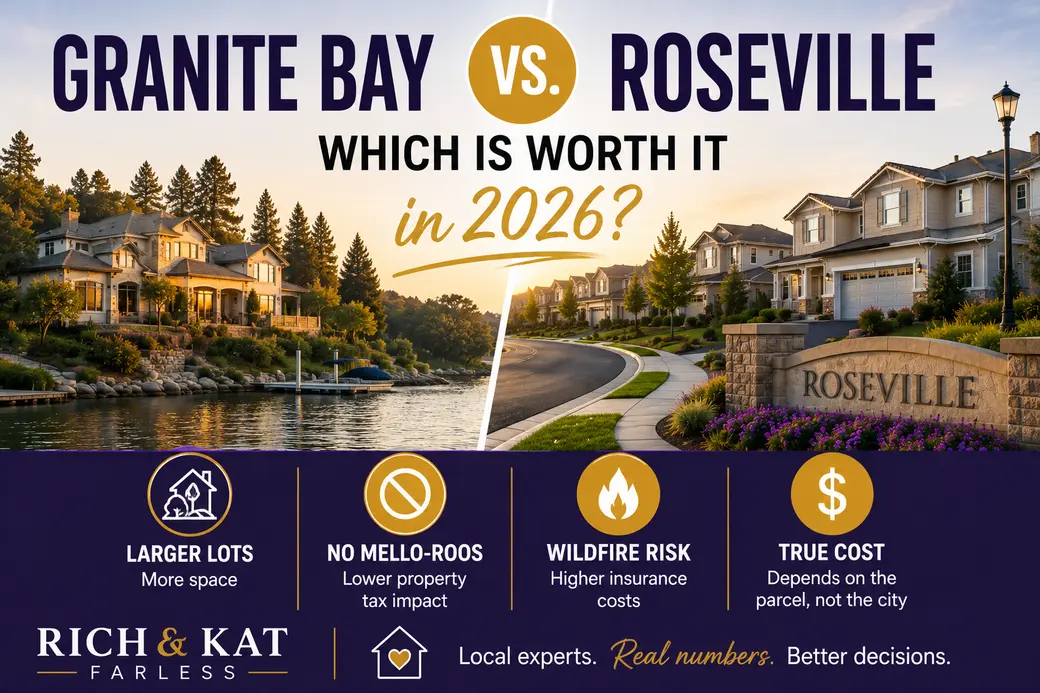
Is Granite Bay worth the premium over Roseville?
It depends on which number you're comparing. At the same purchase price, a Granite Bay home usually carries a lower monthly payment than a West Roseville home — no Mello-Roos, often no HOA. But Granite Bay's median price is roughly double Roseville's (about $1.27M–$1.34M versus $630K–$660K in mid-2026), and once you add wildfire-exposed insurance, PG&E instead of Roseville Electric, and septic or well upkeep, the true cost of ownership swings back the other way. The right answer depends on the specific parcel, not the city name.
By Rich & Kat Farless | August 16, 2026
Buyers ask us this constantly, and almost always in the same shape: "We love the lots in Granite Bay, but is it actually worth twice the money?"
It's a fair question, and most of the content out there answers it with lifestyle talk — lake access, lot size, commute times. That's all real. But nobody runs the carrying-cost math, and the carrying-cost math is where the surprises live.
So let's run it.
What the same $850,000 buys in each market
Start here, because this is the part that reframes the whole decision.
In Roseville, $850,000 puts you well above the market. The median sale price sat around $630,000 in mid-2026, so at $850K you're shopping the top tier — newer construction in West Roseville, 2,500 to 3,200 square feet, a builder warranty, and modern systems. In a Winding Creek or Amoruso Ranch phase, that's a well-appointed new build.
In Granite Bay, $850,000 is the entry point. The median list price hovered between $1.33M and $1.34M through the summer of 2026, with an average single-family sale price near $1.49M and pricing around $431–$444 per square foot. At $850K, you're realistically looking at roughly 1,900 to 2,100 square feet, usually built between the mid-1970s and mid-1990s, often with original kitchens, original HVAC, and a roof approaching the end of its life.
Same check. Very different house.
That's not a knock on Granite Bay — it's the nature of a market where the housing stock is custom, older, and sitting on parcels that are frequently a half acre to several acres. Placer County's Granite Bay Community Plan uses Rural Low Density Residential zoning with minimum lot sizes as large as 40,000 square feet in places. You're buying land as much as you're buying a structure.
The monthly number, side by side
Here's an $850,000 purchase with 20% down ($170,000) in both markets. The $680,000 loan sits under the 2026 conforming limit of $832,750 shared by Placer, Sacramento, and El Dorado counties, so this is a conventional loan on both sides. At roughly 6.625% on a 30-year fixed, principal and interest run about $4,354 per month either way.
Everything after that diverges.
West Roseville (newer construction, inside a CFD):
Base property tax at ~1.1%: $779/mo
Mello-Roos CFD (Westpark, Fiddyment Farm, and similar districts run roughly $2,500–$4,500/yr): ~$275/mo
Lighting and landscaping assessments: ~$33/mo
HOA: ~$177/mo
Homeowners insurance (Roseville averages roughly $2,100/yr): ~$175/mo
Total: about $5,793/mo
Granite Bay (established home, unincorporated Placer County):
Base property tax at ~1.10% (the 95746 median effective rate): $779/mo
Mello-Roos: $0 — most of Granite Bay was built out before the CFD era
Minor assessments: ~$12/mo
HOA: $0 on most non-gated parcels
Homeowners insurance (foothill and oak-woodland exposure, call it $3,600/yr): ~$300/mo
Total: about $5,445/mo
At the same price, Granite Bay comes in roughly $348 a month cheaper — about $4,180 a year. That surprises almost everyone, and it's entirely because Roseville's newer neighborhoods carry the special taxes and HOA dues that paid for the infrastructure, and Granite Bay's older ones don't.
The costs that don't show up on a lender's worksheet
Then the other side of the ledger arrives.
Utilities. Roseville has its own municipal utility. Roseville Electric ran about 20¢/kWh in 2026. Granite Bay is unincorporated, which means PG&E — frequently double that per kilowatt-hour. On a larger home with more square footage to condition, that gap alone can run $150–$250 a month.
Septic and well. Plenty of Granite Bay is on San Juan Water District and public sewer, but plenty isn't. If your parcel is on septic, budget $250–$600 for a pre-purchase inspection, a pump every three to five years, and the possibility of a full replacement at $8,000–$25,000 in Placer County. A private well adds flow and water-quality testing, plus a pump that eventually fails. A realistic reserve is $100–$200 a month, and it's real money whether you set it aside or not. We wrote a full breakdown of what to inspect on a well and septic property that applies directly to Granite Bay acreage.
Acreage upkeep. An acre of oak woodland is not a 5,000-square-foot builder lot. Between defensible-space clearing, tree work, irrigation, and general maintenance, $150–$400 a month is normal.
Add those back and the Granite Bay parcel lands right around $5,845 — a few hundred dollars above the Roseville home, on the same purchase price. The premium didn't disappear. It just moved off your mortgage statement.
The jump most buyers are actually making
The $850K comparison is useful, but it isn't what most people are weighing. The real decision is usually the median-to-median move: a $650,000 Roseville home versus a $1,270,000 Granite Bay home.
That's a different conversation entirely.
Down payment at 20%: $130,000 versus $254,000
Loan amount: $520,000 versus $1,016,000
Principal and interest: roughly $3,330/mo versus roughly $6,597/mo at jumbo pricing
Base property tax: about $596/mo versus about $1,164/mo
And there's a financing wall in the middle of it. With 20% down, you cross the $832,750 conforming limit at a purchase price of about $1,040,938. Roseville's median sits comfortably below that line. Granite Bay's median sits well above it — which means most Granite Bay buyers are in jumbo territory, with tighter credit standards, higher reserve requirements, and a different underwriting experience. Our guide to jumbo loans in Granite Bay and Loomis walks through what lenders actually want to see.
The long-term case for Granite Bay is real, by the way. Its median has climbed from roughly $535,000 in 2010 to about $1,265,000 in 2026 — a 136% increase that reflects durable demand for a limited, land-constrained housing stock. But that's an appreciation argument, not a monthly-payment argument, and you have to be able to carry the payment to collect the appreciation.
Three things to verify before you commit either way
1. Pull the actual tax bill for the actual parcel. Not the city average. Mello-Roos is a fixed line item tied to a specific district and lot, not a percentage of value — two homes on the same Roseville street can carry different assessments with different expiration dates. Our Mello-Roos guide for Roseville buyers explains how to read it off the preliminary title report.
2. Get a bindable insurance quote before you remove contingencies. Granite Bay is unincorporated, so the Placer County Fire Hazard Severity Zone map applies, and designations vary parcel to parcel. A quote is an estimate. A bindable quote is a commitment. Get the second one, in writing, while your inspection contingency is still intact.
3. Don't infer anything from the mailing address. Granite Bay is a census-designated place, not a city. Some homes carry Roseville mailing addresses but sit in unincorporated Placer County — which changes your electric provider, your service agencies, and your school attendance boundaries. Eureka Union School District, for instance, spans parts of both East Roseville and Granite Bay. Verify the parcel with the county, not the envelope.
None of this is a reason to pick one over the other. It's a reason to price the parcel rather than the postcode. We've had clients discover that the Granite Bay home they assumed was out of reach actually pencils out — and clients who found the Roseville new build they loved carried $500 a month they hadn't budgeted for. The only way to know is to run both sets of numbers against your actual loan terms. That's exactly the conversation we have with buyers before they start touring.
If you want the full cost picture on the Granite Bay side, our complete cost-to-buy breakdown for Granite Bay has the line-item detail.
Frequently Asked Questions
Does Granite Bay have Mello-Roos?
Most of Granite Bay does not. The community was largely built out before Community Facilities Districts became standard practice in California, so the majority of parcels carry only the base property tax rate — around 1.10% in the 95746 ZIP code — plus small local assessments. Always confirm on the specific parcel's tax bill, since exceptions exist.
Is Granite Bay part of Roseville?
No. Granite Bay is an unincorporated census-designated place in Placer County, immediately east of Roseville. That distinction matters practically: unincorporated parcels are served by PG&E rather than Roseville Electric, fall under Placer County's Fire Hazard Severity Zone mapping, and receive county rather than city services.
Why is Granite Bay so much more expensive than Roseville?
Land and scarcity. Granite Bay's zoning favors large parcels — Rural Low Density Residential with minimum lot sizes reaching 40,000 square feet in places — and the community is essentially built out, so new supply is minimal. Roseville, by contrast, has active master-planned development in Amoruso Ranch, Winding Creek, Sierra Vista, and Placer One, which keeps inventory flowing at more accessible price points.
Do I need a jumbo loan to buy in Granite Bay?
Often, yes. With 20% down, you cross the 2026 conforming limit of $832,750 at a purchase price of roughly $1,040,938, and Granite Bay's median sits above that. You can sometimes avoid jumbo financing with a larger down payment or a piggyback structure — worth pricing out with your lender before you shop.
Which market gives buyers more negotiating room right now?
Granite Bay, on time. Homes there posted a median 49–57 days on market through the summer of 2026 with sales closing near 98.8% of asking, while Roseville sat around 2.1 months of supply and roughly 98.7% of list. Longer marketing times in the luxury tier generally mean more willingness to negotiate terms, credits, and repairs — though pricing discipline has held in both markets.
The bottom line
Granite Bay isn't more expensive because of taxes — its base rate is essentially the same as Roseville's, and it usually skips Mello-Roos and HOA dues entirely. It's more expensive because of what it costs to get in the door, and because of the ownership costs that never appear on a loan estimate: insurance, PG&E, septic, and acreage.
Roseville buys you more house and more predictability for the money. Granite Bay buys you land, privacy, and a market with a long track record of appreciation. Both are defensible choices. Neither one is knowable from a listing page.
If you're weighing these two markets — or trying to figure out whether stretching to Granite Bay actually works with your numbers — Rich & Kat are here to help. Schedule a free consultation at richandkatsoldthat.com/talktous.
About Rich & Kat Farless
Rich and Kat Farless are a husband-and-wife real estate team with over 30 years of combined experience serving buyers and sellers across the Sacramento region. As the #1 husband-and-wife team in Roseville, CA, they specialize in single family, new construction, and luxury properties across Placer, Sacramento, and El Dorado counties. Connect with them at richandkatsoldthat.com.
All figures are estimates current as of August 2026 and are provided for general information only. Property taxes, special assessments, insurance premiums, and loan terms vary by parcel and by borrower. Verify all numbers with the Placer County Assessor, a licensed insurance agent, and your lender before making a purchase decision. Rich & Kat Farless are licensed real estate agents with eXp Realty, not tax advisors, attorneys, or insurance professionals.
Categories
- All Blogs (77)
- Buyer Guides (2)
- Buyers (1)
- Buying a Home (7)
- First-Time Buyers (2)
- Sellers (2)
- Buyer Resources (1)
- buyers (4)
- Buying (4)
- Buying a Home (14)
- Buying a Home, New Construction, Placer County, Roseville (1)
- California Process (1)
- California Real Estate (2)
- California Real Estate Process (10)
- Cost of Buying (2)
- Cost of Homeownership (1)
- Cost to Buy (2)
- Costs & Finances (6)
- El Dorado County (1)
- El Dorado Hills (1)
- Financing & Mortgages (3)
- First-Time Buyers (1)
- Folsom (2)
- Granite Bay (1)
- HOA (1)
- Home Buying (1)
- Home Financing (1)
- Home Prep & Pricing (1)
- Home Selling (3)
- Home Selling Tips (2)
- Lincoln CA (1)
- Loomis (2)
- New Construction (5)
- placer county (1)
- Real Estate Process (1)
- repairs (1)
- Roseville Real Estate (4)
- Seller Costs (2)
- Seller Guides (1)
- Seller Resources (1)
- sellers (3)
- Selling (4)
- selling a home (11)
Recent Posts




Agent License ID: 01193836, 01186753
+1(916) 284-1520 | kat@homesbyrichandkat.com