How to Ask the Seller to Buy Down Your Mortgage Rate in Roseville, CA
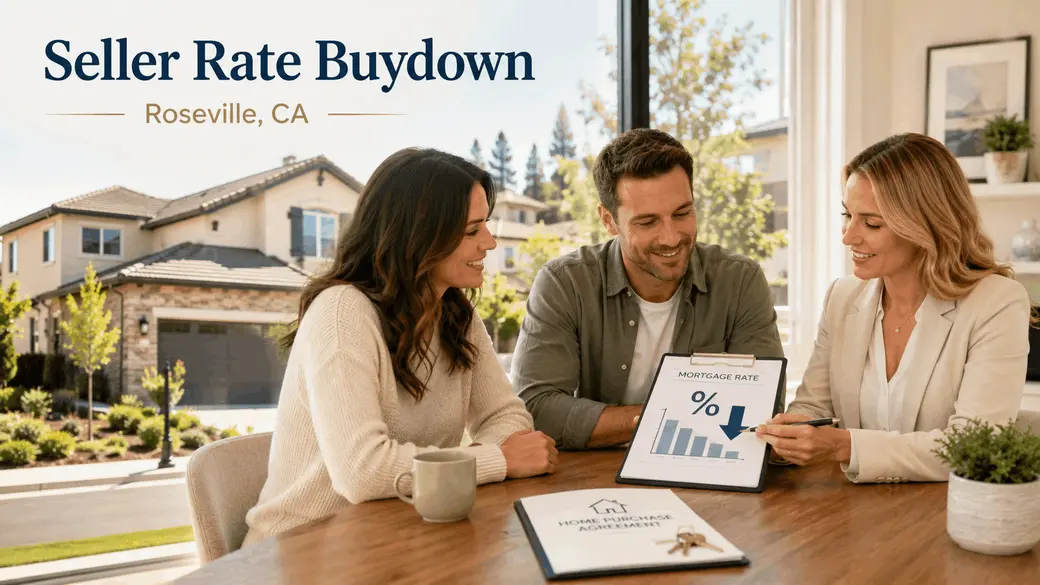
Can You Ask a Seller to Buy Down Your Mortgage Rate?
Yes — and in Roseville's current market, it's one of the most powerful negotiating moves available to buyers. A seller-paid rate buydown is a closing cost credit the seller pays to reduce your mortgage interest rate, either temporarily for the first 1–2 years (called a 2-1 buydown) or permanently for the life of the loan (called discount points). With Roseville-area mortgage rates sitting in the 6.5–7.2% range in mid-2026, a well-negotiated buydown can shave $400 or more off your monthly payment in year one — for the same dollar amount you'd spend trying to get a price reduction.
By Rich & Kat Farless | June 30, 2026
If you're buying a home in Roseville right now, you already know the math is tight. Rates are elevated, prices in West Roseville and Granite Bay have held firm, and a $650,000 home at 7% costs roughly $800 more per month than it would have at 4%. Waiting for rates to drop feels like a gamble. Asking the seller to just cut the price feels like a long shot — and even when it works, the savings per month are smaller than most buyers expect.
Here's what a lot of buyers don't know: there's a third option, and in Roseville's current market, sellers are often more willing to say yes to it than to a price cut. It's called a seller-paid rate buydown. And if you know how to ask for it — and when — it can make a real difference in what you pay every single month.
What Is a Seller-Paid Rate Buydown?
A rate buydown is exactly what it sounds like: you're prepaying money upfront to lower your interest rate. Normally, the buyer covers this cost — it's the same concept as paying mortgage points. But in a negotiation, the seller can be asked to cover it instead, treating it as a seller concession that runs through escrow and shows up on your Closing Disclosure.
There are two types worth knowing:
Temporary buydown (the 2-1 buydown): This is the most common structure in negotiations right now. The seller pays a lump sum at closing that buys your rate down by 2 percentage points in year one and 1 point in year two. In year three — and for the rest of your loan — you're at your original note rate. The funds are held in a custodial account and applied to your monthly payment on the lender's side. You don't manage it; you just see a lower payment.
On a $550,000 loan at a 7% note rate, a 2-1 buydown means:
- Year 1: You pay at 5% — roughly $2,952/month (P&I)
- Year 2: You pay at 6% — roughly $3,298/month
- Year 3+: You pay at 7% — roughly $3,661/month
That's over $700 less per month in year one compared to paying at the full note rate. The cost to the seller for that buydown? Roughly $10,000–$13,000 on that loan size — a meaningful concession, but often still less than a full price reduction would be.
Permanent buydown (discount points): One discount point costs 1% of your loan amount and permanently reduces your rate by roughly 0.25%. On a $550,000 loan, one point = $5,500 and saves approximately $90–100/month for the life of the loan. This can be worth it if you plan to stay in the home at least 5–6 years. Sellers can be asked to pay for discount points just like any other closing cost credit.
Which structure makes more sense depends on how long you plan to stay in the home and whether you think rates will drop enough in the next 2–3 years to refinance. A temporary 2-1 buydown is essentially a bet that rates will soften — or that your income will grow — before year three arrives.
When Does This Strategy Actually Work in Roseville?
The honest answer: not on every house. Roseville isn't a full buyer's market — it's more like a balanced market in most neighborhoods, with pockets of competition still happening in desirable parts of West Roseville and Granite Bay. But the inventory data from mid-2026 is encouraging for buyers who want to negotiate.
As of June 2026, the median days on market in Roseville hit 65 days — the same as a year ago, and up from the faster-moving pace of 2022–2023. Active inventory is up roughly 30–40% year-over-year. And Sacramento-area market reports from April 2026 show approximately half of sales in Folsom, Roseville, and Elk Grove included some form of seller concession.
That tells you something important: in the current Roseville market, concessions are happening. The question isn't whether sellers are open to them — it's whether you're asking the right way.
Here are the conditions where a buydown request is most likely to succeed:
The home has been on the market 30+ days. After a month without an accepted offer, most sellers have recalibrated. They know a price reduction is coming or they're open to alternatives. A buydown request tied to a serious offer is often more appealing to them than dropping their list price (which hits comps and psychological anchor points).
The seller has already made a price reduction. One price cut is a signal that they're willing to negotiate — and that they're trying to close, not hold out.
It's a resale home in a neighborhood with rising inventory. The parts of Roseville and Rocklin where resale supply has increased most are where you'll have the most leverage.
New construction in West Roseville. This is actually where buydowns are most accessible right now. Builders in communities like Winding Creek, Fiddyment Farm, and Amoruso Ranch are actively offering rate buydown incentives — often packaged with closing cost credits and upgrade allowances — when you use their preferred lender. These aren't always the best total deal (we walk through why in our breakdown of new construction vs. resale monthly payments), but the buydown component is real and worth negotiating around.
How to Structure Your Offer to Get a Seller-Paid Buydown
The key to getting a concession accepted is making it easy for the seller to say yes. That means being specific about the amount, keeping the purchase price at or near list, and making sure your agent frames the request in a way that doesn't feel like a lowball.
Here's how it works in practice:
Step 1: Get your lender to calculate the cost first. Before you make an offer, call your lender and ask: "What would a 2-1 buydown cost on a $X loan?" They can give you a precise dollar figure. This matters because you're going to ask for a specific seller credit — not a vague concession.
Step 2: Write the offer at or near list price with a specific seller credit. For example: "Offer $680,000 with $12,500 in seller-paid closing costs to be applied toward a 2-1 interest rate buydown." This is cleaner and more persuasive than asking the seller to just drop the price by $12,500. You're signaling that you know what you want and you're ready to close.
Step 3: Know your loan type limit. Every loan type caps how much a seller can contribute:
- Conventional with less than 10% down: 3% max
- Conventional with 10–25% down: 6% max
- Conventional with 25%+ down: 9% max
- FHA: 6% max
- VA: 4%+ (varies by situation)
- USDA: 6% max
A 2-1 buydown on a $600,000 loan might cost $12,000–$18,000 — which represents 2–3% of the purchase price. Run the numbers to confirm it fits within your loan type's concession limit.
Step 4: Let your agent negotiate the framing. Sellers often resist price cuts because they feel it devalues their home. A rate buydown credit doesn't affect the recorded sales price — the home still sells at $680,000, which matters for comps in the neighborhood. When your agent explains the ask that way, many sellers find it far more palatable than a straight price reduction.
Once the offer is accepted, the credit flows through escrow and shows up on your Closing Disclosure. Your lender handles the mechanics of setting up the buydown account. You'll see it working the moment your first statement arrives.
For a full breakdown of what buyers pay at closing beyond a rate buydown, see our complete guide to buyer closing costs in Roseville.
What About Permanent Points Instead?
If you're planning to stay in the home for 7 or more years and you don't expect to refinance in the near term, asking for seller-paid discount points for a permanent rate reduction can be smarter than a temporary buydown.
The rough break-even math: if one point ($5,500 on a $550K loan) reduces your rate by 0.25% and saves $95/month, you break even in about 58 months — just under five years. After that, you're ahead every month for as long as you own the home.
In a higher-priced Roseville purchase — say, $900,000 in Granite Bay or West Roseville — asking for two permanent points is a reasonable ask in a negotiation and can save you close to $200/month for the life of the loan.
Whether you go temporary or permanent, the strategic principle is the same: the dollar amount you're asking the seller to contribute delivers more monthly cash flow relief than the equivalent amount in a price reduction. That's the core argument you and your agent are making at the table.
FAQ
What is a 2-1 buydown and how does it work in California? A 2-1 buydown is a seller-paid concession that temporarily reduces your mortgage interest rate — by 2% in year one and 1% in year two, before returning to your full note rate in year three. The seller contributes a lump sum at closing (typically 2–3% of the loan amount), which is held by your lender and applied to reduce your monthly payment during the buydown period. It's legal in California and processed through the title and escrow company like any other closing cost credit.
Can a seller in California pay for a rate buydown? Yes. A seller can pay for a temporary or permanent rate buydown as a seller concession, as long as the amount doesn't exceed the limit for your loan type. For conventional loans, the cap ranges from 3% to 9% of the purchase price depending on your down payment. FHA caps seller concessions at 6%, and VA at 4% or more. Your lender will confirm the exact limit for your situation.
Is a seller-paid rate buydown better than asking for a price reduction in Roseville? In most cases, yes — because the monthly payment relief is greater dollar for dollar. A $12,000 price reduction saves roughly $72/month on a 30-year loan at 7%. The same $12,000 applied to a 2-1 buydown can save $400–$700/month in year one. Sellers also often prefer buydowns over price cuts because the recorded sales price stays the same, which matters for neighborhood comps.
Do new construction builders in Roseville offer rate buydowns? Yes. Builders in West Roseville communities like Winding Creek, Fiddyment Farm, and Placer One are actively offering rate buydown incentives as part of their sales packages in 2026, typically paired with preferred lender use. These incentives are worth analyzing carefully — our team can help you compare the builder's offer against what you could negotiate on an equivalent resale home.
When is it too risky to ask for seller concessions in Roseville? In a competitive multiple-offer situation, asking for concessions can cost you the deal. If a home just listed and you're expecting multiple offers, a clean offer is usually stronger. Concession requests work best when the home has been sitting 30+ days, has already had a price reduction, or the seller has signaled flexibility. Your agent's read on the seller's situation is the most important factor.
Ready to Put This Strategy to Work?
Understanding the mechanics of a rate buydown is the first step. Knowing when and how to use it in a live negotiation — in a specific Roseville neighborhood, against a motivated seller, with the right offer structure — is where an experienced local agent makes the difference.
Rich and Kat Farless have been negotiating on behalf of buyers across Roseville, Granite Bay, Folsom, Lincoln, and Loomis for decades. If you're trying to buy in this market without leaving money on the table, let's talk through your situation before you make an offer.
Schedule a free consultation at richandkatsoldthat.com/talktous
Rich and Kat Farless are a husband-and-wife real estate team with over 30 years of combined experience serving buyers and sellers across the Sacramento region. As the #1 husband-and-wife team in Roseville, CA, they specialize in single family, new construction, and luxury properties across Placer, Sacramento, and El Dorado counties. Connect with them at richandkatsoldthat.com.
Categories
- All Blogs (89)
- Buyer Guides (3)
- Buyers (2)
- Buying a Home (7)
- First-Time Buyers (2)
- Loomis (1)
- Seller Costs (1)
- Sellers (4)
- Buyer Resources (1)
- buyers (4)
- Buying (4)
- Buying a Home (14)
- Buying a Home, New Construction, Placer County, Roseville (1)
- California Process (1)
- California Real Estate (2)
- California Real Estate Process (11)
- Cost of Buying (2)
- Cost of Homeownership (1)
- Cost to Buy (2)
- Costs & Finances (6)
- El Dorado County (1)
- El Dorado Hills (1)
- Financing & Mortgages (3)
- First-Time Buyers (1)
- Folsom (2)
- Granite Bay (2)
- HOA (1)
- Home Buying (1)
- Home Financing (1)
- Home Prep & Pricing (1)
- Home Selling (3)
- Home Selling Tips (2)
- Lincoln CA (2)
- Loomis (2)
- New Construction (6)
- placer county (1)
- Real Estate Process (1)
- repairs (1)
- Roseville Real Estate (4)
- Seller Costs (2)
- Seller Guides (1)
- Seller Resources (1)
- sellers (3)
- Selling (4)
- selling a home (11)
Recent Posts








Agent License ID: 01193836, 01186753
+1(916) 284-1520 | kat@homesbyrichandkat.com