Rent-Back Agreements in Roseville, CA: How Seller-in-Possession Works
What is a rent-back agreement, and how does it work in California?
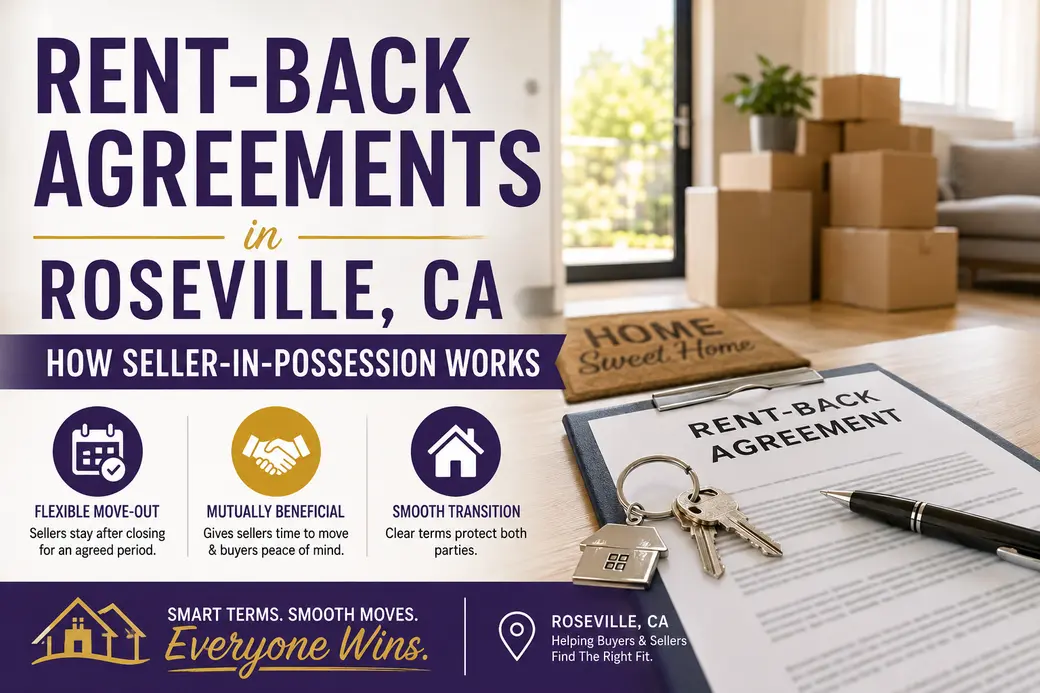
A rent-back agreement lets a seller stay in the home after the sale closes — legally handing you the keys and the title while they remain in possession for a set number of days. In California, short stays of 29 days or fewer usually run on the C.A.R. Seller in Possession (SIP) addendum, while stays of 30 days or more use the Residential Lease After Sale (RLAS) and turn the buyer into a landlord. Rent is typically set at the buyer's new daily carrying cost, and a deposit held in escrow protects the buyer against damage or a seller who won't leave.
By Rich & Kat Farless | August 1, 2026
If you're selling in Roseville right now, you've probably run into the scariest math in real estate: you need the equity from your current home to buy the next one, but you can't buy the next one until this one closes — and you can't close this one without knowing where you'll sleep the following night.
That gap is exactly what a rent-back solves.
It's one of the most common questions we get from move-up sellers in West Roseville and downsizers in Sun City Roseville, and it comes up constantly on Reddit and in buyer-seller negotiations across Placer County. In a balanced-but-competitive 2026 market — median sale price around $635,000, roughly 2.1 months of supply, and rates holding in the mid-6% range — flexible possession has quietly become one of the strongest offer terms on the table. Here's how it actually works, what it costs, and where it can go wrong.
SIP vs. RLAS: the 29-day line that changes everything
California has two standard forms for a seller staying after close, and the one you use depends entirely on how long the seller needs.
Seller in Possession (SIP) — up to 29 days. This is a short C.A.R. addendum to the purchase agreement — about two pages. Legally, it's treated as a license, not a lease. The seller is still called "Seller," you're still "Buyer," and the money the seller puts up is called a Delivery of Possession Fee, not a security deposit. It's built to be simple and short.
Residential Lease After Sale (RLAS) — 30 days or more. The moment the stay hits 30 days, California treats it as a full landlord-tenant relationship. The RLAS is a much longer document — roughly eight pages, closer to fifteen with attachments — because tenant rights, disclosures, deposit rules, and just-cause protections all attach. As the buyer, you're now a landlord, with everything that comes with it.
Here's the part people miss: a court can reclassify a SIP as a lease if the facts start to look like a tenancy — ongoing rent, occupancy dragging past 29 days, the seller settling in. That's why the 29-day line matters so much. If you genuinely need a short overlap, keep it short and keep it clean. If you know it'll be a month or more, use the RLAS from the start and go in with your eyes open.
One more piece of fine print worth knowing: the C.A.R. purchase agreement itself flags that both parties should talk to their insurance and legal advisors about liability, damage, and injury risk while the seller stays after close. That's not boilerplate you should skim past — more on that below.
What a rent-back costs — and the "free" version
Rent on a rent-back isn't set like market rent. It's usually pegged to the buyer's new daily carrying cost — your mortgage payment, including principal, interest, taxes, and insurance (PITI), divided by 30 to get a daily rate.
Run the math on a typical Roseville deal:
A financed buyer on a median-priced (~$635,000) home often has a PITI around $3,800 to $4,300 a month.
That's roughly $127 to $143 a day.
A 30-day rent-back at that rate runs about $3,800 to $4,300 — paid by the seller to the buyer, usually credited or handled through escrow.
Now the term you'll hear in competitive offers: the "free" rent-back. In a multiple-offer situation on a well-priced listing, a buyer might offer the seller 30 or even 60 days of possession at no rent to make their offer stand out. The seller still typically puts up a possession fee or deposit to cover damage — "free" refers to the rent, not the risk.
We've watched this term win deals that price alone didn't. If two offers are close and one lets the seller stay through the end of the school semester or until their new build finishes, that flexibility can matter more than another few thousand dollars. This is one of the reasons a rent-back shows up so often when we help clients figure out how to buy and sell a home at the same time in Roseville — it turns a timing problem into a negotiating chip.
If you're weighing offer strength from the other side, a stronger deposit and clean possession terms send the same signal that a healthy earnest money deposit does: this buyer is serious and organized.
The lender and insurance limits nobody warns you about
Two behind-the-scenes rules quietly cap how a rent-back can be structured.
Your lender is watching the clock. If you're buying with an owner-occupied loan — which almost everyone is — the lender generally allows a rent-back of only up to about 59 to 60 days. Go longer and you can run afoul of the loan's owner-occupancy requirement, because you're not the one living there yet. Always confirm the exact limit with your lender before you agree to a term. This is a hard line, not a suggestion.
Your new insurance may not cover the seller's stuff — or their accidents. The day escrow closes, you own the house, but the seller is the one living in it. Your brand-new homeowner's policy may not cover damage or an injury caused by the occupant-seller during the rent-back. The cleanest fix is for the seller to keep a renter's or homeowner's policy in force through the possession period. Both sides should call their insurance advisor and confirm coverage in writing before the keys change hands. It's a five-minute call that can prevent a five-figure headache.
What if the seller won't leave?
This is the fear that keeps buyers up at night, and it's a fair one — you now own a home, you're paying for it, and someone else is living in it.
Here's what protects you:
A deposit or possession fee held in escrow. You do a walk-through at handover and again at move-out. If the home comes back in materially worse shape than agreed, that money is your recourse.
A per-diem holdover penalty. A well-written agreement sets a daily penalty for staying past the agreed date — usually well above the normal daily rate — so the seller has a real financial reason to be out on time.
The 29-day SIP cap limits your exposure. Because a SIP is a license and stays short, your downside is contained. A 30-plus-day RLAS gives you more structure but also loads you with full landlord obligations if things go sideways, including the formal eviction process if it ever came to that.
In practice, holdovers are rare when the agreement is written tightly, the term is realistic, and both sides know the penalties up front. The problems we see almost always trace back to a vague, handshake-style arrangement — not a properly papered one. This is exactly the kind of detail we walk our clients through before anyone signs, right alongside what to expect on closing day in California.
When a rent-back is the right move in Placer County
A rent-back isn't for every deal, but it's tailor-made for a handful of very common local situations:
Move-up sellers who need to close and cash out their equity before they can qualify for and close on the next home.
New-construction buyers whose build in Winding Creek, Amoruso Ranch, Fiddyment Farm, or Heritage Placer Vineyards finishes weeks after their current home sells. Selling first, then renting back until the new home is ready, bridges the gap without two mortgages.
Downsizers in Sun City Roseville and Sun City Lincoln Hills who want to sell into strong demand but need time to sort, pack, and move a lifetime of belongings.
Relocating families — including the out-of-area buyers arriving with Bosch's new semiconductor investment and the Kaiser and Sutter campuses — who close on a tight timeline and need a few weeks of breathing room.
If any of that sounds like your situation, the decision often ties directly into the bigger question of whether to sell now or wait in Roseville. Timing your sale and your possession terms together is where a good plan turns into a smooth move.
Frequently Asked Questions
How long can a seller stay in the house after closing in California?
It depends on the form. A Seller in Possession (SIP) addendum covers stays of up to 29 days as a license. For 30 days or more, you use a Residential Lease After Sale (RLAS), which creates a full landlord-tenant relationship. Most lenders on owner-occupied loans also cap the total rent-back at around 59 to 60 days, so confirm your limit before agreeing to a term.
How much rent does a seller pay during a rent-back?
Rent is usually set at the buyer's new daily carrying cost — the full mortgage payment (principal, interest, taxes, and insurance) divided by 30. On a median-priced Roseville home, that often works out to roughly $127 to $143 a day. In competitive offers, buyers sometimes waive the rent entirely as a concession, though the seller still typically posts a deposit for damage.
Is a "free" rent-back really free?
The rent is free, but the risk isn't. In a "free" rent-back, the buyer forgoes charging rent to make their offer more attractive, but the seller still generally puts up a possession fee or deposit held in escrow to cover any damage or a late move-out. It's a negotiating tool, not a giveaway.
What happens if the seller doesn't move out on time?
A properly written agreement includes a per-diem holdover penalty — usually well above the daily rate — plus a deposit the buyer can draw against. Because a SIP is capped at 29 days, exposure stays limited. If a stay runs 30-plus days under an RLAS and the seller won't leave, the buyer has landlord remedies, up to the formal eviction process, which is exactly why tight, written terms matter.
Does my homeowner's insurance cover the home during a rent-back?
Not necessarily. Your new policy may not cover damage or injury caused by the occupant-seller before you move in. The seller should keep a renter's or homeowner's policy in force through the possession period, and both parties should confirm their coverage in writing with an insurance advisor before closing.
The bottom line
A rent-back is one of the most useful — and most misunderstood — tools in a California transaction. Used right, it closes the gap between selling one home and moving into the next, and it can win or save a deal in a competitive market. Used carelessly, with a vague term and no paperwork, it creates exactly the mess buyers fear. The difference is almost always in the details: the right form, a realistic timeline, a lender sign-off, confirmed insurance, and a deposit that actually protects you.
Every transaction is different, and the only way to know whether a rent-back fits your move — and how to structure it so it protects you — is to run your specific numbers and timeline with someone who negotiates these terms in this market every week.
If you're ready to talk through your situation — whether you're buying, selling, or trying to line up both at once — Rich & Kat are here to help. Schedule a free consultation at richandkatsoldthat.com/talktous.
About Rich & Kat Farless
Rich and Kat Farless are a husband-and-wife real estate team with over 30 years of combined experience serving buyers and sellers across the Sacramento region. As the #1 husband-and-wife team in Roseville, CA, they specialize in single family, new construction, and luxury properties across Placer, Sacramento, and El Dorado counties. Connect with them at richandkatsoldthat.com.
Categories
- All Blogs (81)
- Buyer Guides (3)
- Buyers (2)
- Buying a Home (7)
- First-Time Buyers (2)
- Sellers (3)
- Buyer Resources (1)
- buyers (4)
- Buying (4)
- Buying a Home (14)
- Buying a Home, New Construction, Placer County, Roseville (1)
- California Process (1)
- California Real Estate (2)
- California Real Estate Process (11)
- Cost of Buying (2)
- Cost of Homeownership (1)
- Cost to Buy (2)
- Costs & Finances (6)
- El Dorado County (1)
- El Dorado Hills (1)
- Financing & Mortgages (3)
- First-Time Buyers (1)
- Folsom (2)
- Granite Bay (1)
- HOA (1)
- Home Buying (1)
- Home Financing (1)
- Home Prep & Pricing (1)
- Home Selling (3)
- Home Selling Tips (2)
- Lincoln CA (1)
- Loomis (2)
- New Construction (5)
- placer county (1)
- Real Estate Process (1)
- repairs (1)
- Roseville Real Estate (4)
- Seller Costs (2)
- Seller Guides (1)
- Seller Resources (1)
- sellers (3)
- Selling (4)
- selling a home (11)
Recent Posts








Agent License ID: 01193836, 01186753
+1(916) 284-1520 | kat@homesbyrichandkat.com