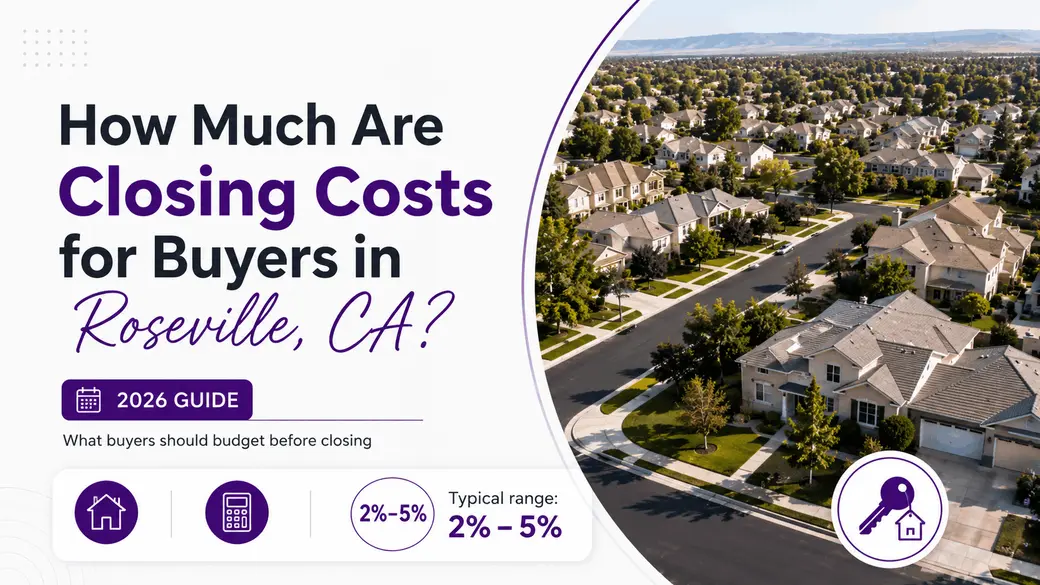
How Much Are Closing Costs for Buyers in Roseville, CA? (2026 Guide)
How Much Are Closing Costs for Buyers in Roseville, CA? (2026 Guide)
How much are closing costs for buyers in Roseville, CA?
Buyers in Roseville typically pay 2–3% of the purchase price in closing costs. On a $650,000 home — close to Roseville's 2026 median — that's roughly $13,000 to $19,500 on top of your down payment. These costs cover lender fees, your share of escrow, title insurance, an appraisal, and prepaid expenses like homeowners insurance and property taxes.
By Rich & Kat Farless | June 13, 2026
You've been saving up for your down payment, running mortgage calculations, and mentally decorating the kitchen — and then your lender sends over a Loan Estimate with a line item called "closing costs" that nobody warned you about. For most buyers in Roseville, Granite Bay, Folsom, and Rocklin, that number lands somewhere between $13,000 and $20,000 on a typical purchase. And yes, that's on top of your down payment.
Here's the thing: closing costs are real, they're required, and they're not negotiable in the way you might hope. But they're also not a mystery. Every dollar has a name and a reason. Once you see the breakdown, you can plan for it — and in some situations, reduce it.
This is what buyer closing costs actually look like in Roseville in 2026, with real numbers you can use.
What Are Buyer Closing Costs and Why Do They Exist?
Closing costs are the fees and prepaid expenses required to finalize your home purchase. They're separate from your down payment. You'll pay them at the closing table — or in some cases, roll a portion into your loan if your lender allows it.
They exist because buying a home involves a lot of third parties: a lender who evaluates your loan, a title company that searches the property's ownership history, an escrow officer who holds funds and coordinates the transaction, a county recorder who records the new deed, and insurance companies that protect both you and your lender going forward.
Think of it this way: the purchase price goes to the seller. Closing costs go to everyone else who made the transaction possible.
In California, buyers and sellers each pay their own share. Your share as a buyer is typically 2–3% of the purchase price. Sellers pay significantly more — usually 6–8% — because they're covering agent commissions, transfer taxes, and the owner's title policy. (If you're selling, check out our breakdown of how much it costs to sell a home in Roseville.)
The Real Numbers: Buyer Closing Costs on a $650,000 Roseville Home
Let's run a real example. The median home value in Roseville is approximately $658,000 as of mid-2026. Here's what a buyer putting 10% down ($65,000) would typically see on their Closing Disclosure — with a loan amount of $585,000:
Lender Fees
These are the fees your mortgage lender charges to originate and process your loan.
- Origination / processing fee: $2,500–$4,500 (some lenders charge a flat fee; others charge a percentage of the loan amount, typically 0.5–1%)
- Underwriting fee: $500–$1,000
- Credit report: $25–$75
- Appraisal: $500–$700 (required by nearly all lenders before they'll fund your loan)
- Rate lock fee: Sometimes included, sometimes charged separately
Lender fees subtotal: roughly $4,000–$7,000
Title and Escrow Fees
In Placer County and Sacramento County, escrow fees are split 50/50 between buyer and seller. The buyer pays for a lender's title insurance policy; the seller typically covers the owner's title policy.
- Lender's title insurance: $600–$1,200
- Buyer's share of escrow fee: $1,100–$1,800 (formula: $250–$450 base + ~$2 per $1,000 of purchase price, split with seller)
- Recording fees (Placer County): $100–$250
Title and escrow subtotal: roughly $1,800–$3,200
Prepaid Expenses
These aren't fees — they're expenses you're prepaying so your lender has the right cushions in place at closing. They're just as real as any other line item.
- Homeowners insurance (12 months prepaid): $1,200–$2,400 (your lender requires proof of a paid policy before funding)
- Property tax escrow (2–6 months, depending on closing date): $1,200–$3,600 (based on Placer County's base tax rate of ~1.1–1.18% of assessed value)
- Prepaid interest: $50–$100/day × days remaining in the month of closing (if you close June 15, you're prepaying 15 days of interest)
Prepaids subtotal: roughly $3,500–$7,000
Inspection Fees (Pre-Closing)
These aren't technically closing costs — you pay them before closing and they don't appear on your Closing Disclosure — but they're out-of-pocket expenses you need to budget for.
- General home inspection: $400–$600
- Pest/termite inspection: $125–$250
Inspection subtotal: roughly $525–$850
Total Estimate: $9,825–$18,050, or roughly 1.5–2.8% of the purchase price
Your actual costs will vary based on your loan type, lender, closing date, and whether you're buying in a development with HOA transfer fees. But this range covers what most Roseville buyers face in 2026.
New Construction in West Roseville: A Different Calculation
If you're buying new construction in Fiddyment Farm, Winding Creek, Amoruso Ranch, or another West Roseville community, your closing cost picture changes in a few key ways.
Builder closing cost credits. Many builders — including DR Horton, Pulte, KB Homes, and Lennar — are currently offering closing cost credits of 2–3% of the purchase price if you use their preferred lender. On a $700,000 home, that's $14,000–$21,000 in credits, which can offset a significant portion of your closing costs or fund a rate buydown. This is a real incentive worth asking about, but it comes with strings: their preferred lender may not offer the most competitive rate, so compare carefully.
Mello-Roos and CFD setup. In virtually every new West Roseville community, you'll carry a Mello-Roos assessment — a special tax that funds local infrastructure like roads, parks, and schools. When you close on a new home, the CFD (Community Facilities District) assessment gets established for your parcel. This may involve a prepayment or prorated amount at closing depending on the district. We covered this in detail in our Mello-Roos guide — it's essential reading before you buy new construction anywhere in West Roseville.
Monthly payment reality check. That builder credit sounds great, but make sure you're comparing total costs correctly. We walked through exactly how new construction and resale monthly payments compare in Roseville — including HOA, Mello-Roos, and insurance — in this side-by-side breakdown.
How to Reduce Your Buyer Closing Costs
You can't eliminate closing costs, but you can reduce them in a few legitimate ways.
Negotiate seller concessions. In California, it's customary for buyers to request that sellers contribute toward closing costs — this is called a seller concession or seller credit. In a balanced market (which is what Roseville looks like in mid-2026, with 2.1 months of supply and homes averaging 73 days on market), sellers are more open to this than they were during the peak. A credit of $5,000–$10,000 is reasonable to request without killing the deal on a well-priced home, depending on the situation.
Shop lender fees. Origination fees, underwriting fees, and rate-lock fees vary significantly between lenders — sometimes by $2,000–$4,000 on the same loan amount. Get at least two Loan Estimates and compare Section A (origination charges) directly.
Choose your closing date strategically. Closing at the end of the month reduces prepaid interest because you're only paying interest for a few days rather than most of the month. On a $585,000 loan at 6.54%, that's about $106/day — closing June 28 instead of June 10 saves roughly $1,900 in prepaid interest.
Roll costs into the loan (with limits). Some loan programs allow you to finance a portion of your closing costs by accepting a slightly higher interest rate. The lender pays your upfront costs, and you pay for it over time through a higher rate. This can make sense if you're cash-constrained, but run the numbers on the long-term cost.
FAQ: Buyer Closing Costs in Roseville, CA
What is included in buyer closing costs in California?
Buyer closing costs in California include lender fees (origination, underwriting, appraisal, credit report), title insurance for the lender, your share of escrow fees, county recording fees, and prepaid expenses including homeowners insurance, property tax escrow reserves, and prepaid mortgage interest. Home inspection fees are additional, paid before closing. Total buyer costs in California typically run 2–3% of the purchase price.
Do buyers pay closing costs in Roseville, CA?
Yes. Buyers in Roseville pay their own closing costs, which are separate from the seller's costs. In Placer County and Sacramento County, escrow fees are split 50/50 between buyer and seller, but each party is responsible for their own lender, title, and prepaid expenses. Sellers pay the larger share overall because they cover agent commissions and transfer taxes. Buyers focus on lender fees, the lender's title policy, prepaid expenses, and their share of escrow.
Can the seller pay my closing costs in California?
Yes — sellers can offer credits toward your closing costs as part of the negotiation. These are called seller concessions or seller credits. Most loan programs cap seller concessions at 3–6% of the purchase price, depending on your down payment. In Roseville's current market, requesting $5,000–$10,000 in seller credits is realistic when making an offer on a home that has been sitting, though it's a trickier ask on a multiple-offer situation.
What are prepaid expenses at closing in California?
Prepaid expenses are amounts you pay at closing for future expenses rather than past services. In California, prepaids typically include: 12 months of homeowners insurance (your lender requires proof of a paid policy), 2–6 months of property tax reserves (held in your escrow account), and prepaid mortgage interest from your closing date through the end of that month. Prepaids are distinct from fees — you're funding future coverage, not paying for a service already rendered.
How much cash do I need to close on a home in Roseville, CA?
At minimum, you need your down payment plus closing costs. On a $650,000 Roseville home with 10% down, that's $65,000 (down payment) plus roughly $13,000–$19,000 (closing costs) — a total cash need of approximately $78,000–$84,000. You should also keep 1–2 months of mortgage payments in reserve after closing, which most lenders prefer and some require. If you're buying with an FHA loan (3.5% down) or VA loan (0% down), your down payment drops, but you may face additional fees like an upfront mortgage insurance premium or VA funding fee.
The Number Nobody Forgets
The first time a buyer sees their Closing Disclosure — a day or two before closing — and spots a line that says "Cash to Close: $82,000" when they thought they needed $65,000 for the down payment, it's a stomach-drop moment. We've been there with a lot of clients. The goal of this post is to make sure that number isn't a surprise when you get there.
If you're actively buying in Roseville, Granite Bay, Folsom, Rocklin, or Lincoln and want a real estimate based on your actual loan type, purchase price, and target close date, we can walk you through it before you're ever sitting at the closing table.
Schedule a free consultation at richandkatsoldthat.com/talktous
About the Authors
Rich and Kat Farless are a husband-and-wife real estate team with over 30 years of combined experience serving buyers and sellers across the Sacramento region. As the #1 husband-and-wife team in Roseville, CA, they specialize in single family, new construction, and luxury properties across Placer, Sacramento, and El Dorado counties. Connect with them at richandkatsoldthat.com.
Categories
- All Blogs (73)
- Buyer Guides (2)
- Buyers (1)
- Buying a Home (6)
- First-Time Buyers (2)
- Sellers (2)
- Buyer Resources (1)
- buyers (4)
- Buying (4)
- Buying a Home (14)
- Buying a Home, New Construction, Placer County, Roseville (1)
- California Process (1)
- California Real Estate (2)
- California Real Estate Process (10)
- Cost of Buying (2)
- Cost to Buy (2)
- Costs & Finances (5)
- El Dorado County (1)
- El Dorado Hills (1)
- Financing & Mortgages (3)
- First-Time Buyers (1)
- Folsom (2)
- Granite Bay (1)
- HOA (1)
- Home Buying (1)
- Home Financing (1)
- Home Prep & Pricing (1)
- Home Selling (3)
- Home Selling Tips (2)
- Lincoln CA (1)
- Loomis (2)
- New Construction (5)
- placer county (1)
- Real Estate Process (1)
- repairs (1)
- Roseville Real Estate (4)
- Seller Costs (2)
- Seller Resources (1)
- sellers (3)
- Selling (4)
- selling a home (11)
Recent Posts





Agent License ID: 01193836, 01186753
+1(916) 284-1520 | kat@homesbyrichandkat.com