How Much Earnest Money Do You Need in Roseville, CA?

How much earnest money do you need to buy a house in Roseville, and is it refundable?
In Roseville, earnest money typically runs 1% to 3% of the purchase price — roughly $6,500 to $19,500 on a median-priced home around $651,000. It's not an extra fee. Your deposit sits in escrow and gets applied to your down payment and closing costs when the sale closes. And yes, it's refundable — as long as you cancel in writing while an inspection, appraisal, or loan contingency is still active. Once you remove your contingencies, that money is at risk, and California law caps what the seller can keep at 3% of the price.
By Rich & Kat Farless | July 28, 2026
If you're about to write an offer in Roseville, one of the first real dollar amounts you'll face is the earnest money deposit — and it's one of the most common things buyers ask us about. It's a check for thousands of dollars, written before you own anything, and the fear underneath the question is always the same: What if I lose it?
Here's the good news. Earnest money isn't a gamble when you understand how it works. In California, the contract is built to protect you at every stage — right up until the moment you decide to give up that protection. Let's walk through exactly how much you'll need, where the money goes, and the specific situations where it's refundable versus at risk.
What earnest money is — and what it isn't
Earnest money is a good-faith deposit that tells the seller you're serious. When you and the seller sign the California Residential Purchase Agreement, you deposit these funds into escrow with a neutral title and escrow company — not with the seller, and not with our team.
That last part matters. The escrow company holds your money as a neutral third party. It can't be released to anyone until both sides agree, or until a proper contingency release or cancellation is signed. Nobody can quietly pocket your deposit.
And it's not money you're spending on top of everything else. Your earnest money is applied toward your down payment and closing costs at the close of escrow. If you deposit $13,000 on a $650,000 home and you're putting 20% down, that $13,000 becomes part of your $130,000 down payment — not an additional charge. It's your money moving one step earlier in the process.
How much you'll need in Roseville
There's no California law that sets a required amount. It's negotiated between you and the seller, and in practice it tracks the price and the competitiveness of the market.
The standard range in our area is 1% to 3% of the purchase price:
- On a $500,000 home: roughly $5,000 to $15,000
- On the ~$651,000 Roseville median: roughly $6,500 to $19,500
- On a $1,000,000 Granite Bay or Loomis home: roughly $10,000 to $30,000
In a slower market, 1% might be perfectly acceptable. But Roseville is not a slow market right now. Homes here are still selling in around 13 days, and the market scores near the top on competitiveness. When a desirable listing draws multiple offers, a stronger earnest money deposit — say 2% to 3% instead of 1% — signals that you're financially committed and unlikely to walk. It's one of the quiet levers that can separate your offer from the next one without raising your price.
New construction in West Roseville — Fiddyment Farm, Amoruso Ranch, Winding Creek — often works differently. Builders frequently set their own deposit amounts and structures, and those deposits can carry different terms than a resale purchase. If you're buying new, read the builder's contract carefully, because that's one place where the standard C.A.R. protections don't automatically apply. This is exactly the kind of thing we flag for buyers before they sign anything — and one reason it helps to have a buyer's agent on your side when buying new construction.
When your earnest money is refundable
This is the heart of the question, so let's be precise. In California, your deposit is protected by the contingencies in your purchase agreement. As long as a contingency is still active and you cancel in writing within its timeline, you're entitled to a full refund.
The three contingencies that protect most buyers:
- Inspection (investigation) contingency — If the home inspection turns up problems you're not comfortable with, you can cancel and get your deposit back.
- Appraisal contingency — If the property appraises for less than your offer, you can renegotiate, cancel for a refund, or bring extra cash to close. (We wrote a full guide on what to do when the appraisal comes in low.)
- Loan contingency — If your financing falls through despite acting in good faith, you can cancel and recover your deposit.
Under the standard California Residential Purchase Agreement, the default timeline to remove these contingencies is 17 days after acceptance. During that window, you're in the driver's seat. Cancel properly for a valid reason, and your money comes back to you.
The key words are in writing and within the timeline. Escrow won't release your funds on a phone call or a text. The cancellation has to be documented on the right form.
When your earnest money is at risk
Your deposit becomes exposed the moment you remove all your contingencies and then decide not to close. That's the trade. Contingency removal is you telling the seller, "I'm all in" — which is powerful in a competitive offer, but it also lifts the safety net.
We break down that exact moment — the C.A.R. Form CR, the Notice to Perform, and when your money "goes hard" — in our companion guide on contingency removal in California. If you're weighing whether to shorten or waive contingencies to win a bidding war, read that one before you commit.
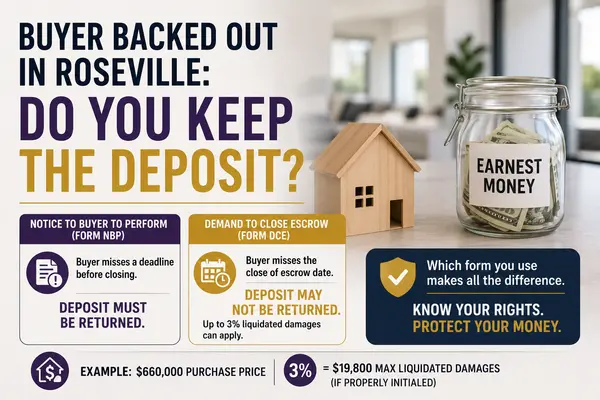
Here's the part that gives most buyers relief: even if you default after removing contingencies, the seller usually can't keep everything. California Civil Code Section 1675 caps the seller's recovery at 3% of the purchase price for a residential property of one to four units where the buyer intended to live. That's the liquidated damages provision, and on a $650,000 home, 3% is $19,500 — the ceiling, not an automatic penalty.
Two things to know about that cap:
- It only applies if both you and the seller separately initialed the liquidated damages clause in the contract. If it wasn't initialed, different rules apply, and disputes may head to mediation or arbitration.
- The 3% figure is a maximum, not a guarantee the seller collects it. Escrow can't release disputed funds until both parties sign off, so these situations often involve negotiation.
The bottom line for Roseville buyers
Earnest money feels scary because it's real money changing hands early. But the structure is designed to protect a buyer who acts in good faith and communicates in writing. Put down enough to make your offer credible in a competitive market, keep your contingencies in place until you're genuinely comfortable, and never remove them without understanding what you're giving up.
The right deposit amount for your offer depends on the specific home, how many other buyers are circling it, and how strong you need to look to win. That's a judgment call, and it's one we make with our clients on every offer we write.
Frequently Asked Questions
How much earnest money should I offer in a competitive Roseville market?
In a competitive situation, 2% to 3% of the purchase price sends a stronger signal than the 1% floor. On the ~$651,000 Roseville median, that's roughly $13,000 to $19,500. A larger deposit tells the seller you're financially committed, which can help your offer stand out without raising your price.
Where does my earnest money go — to the seller?
No. It's deposited with a neutral title and escrow company, not with the seller or the agents. Escrow holds it until closing, when it's applied to your down payment and closing costs, or until a signed contingency release or cancellation directs where it goes.
Can the seller keep my full deposit if I back out?
Usually not. If you cancel while a contingency is still active, you get a full refund. If you default after removing all contingencies, California Civil Code Section 1675 caps the seller's recovery at 3% of the purchase price — and only if both parties initialed the liquidated damages clause.
Is earnest money the same as a down payment?
No, but it becomes part of it. Earnest money is a smaller good-faith deposit made when your offer is accepted, while the down payment is the larger sum due at closing. At the close of escrow, your earnest money is credited toward your down payment and closing costs — so you're not paying it twice.
How long do I have to protect my deposit in California?
Under the standard California Residential Purchase Agreement, the default period to remove your inspection, appraisal, and loan contingencies is 17 days after acceptance. While those contingencies are active, you can cancel in writing for a valid reason and recover your deposit in full. These timelines are negotiable, so confirm the exact dates in your contract.
Ready to write a strong offer?
Earnest money is one of the first real decisions in your purchase, and getting it right — enough to compete, structured to protect you — sets the tone for the whole transaction. It's also just one piece of a larger strategy that includes your buyer closing costs and knowing what happens after your offer is accepted.
If you're getting ready to make an offer in Roseville, Granite Bay, Folsom, Lincoln, or anywhere across Placer, Sacramento, and El Dorado counties, Rich & Kat are here to help you write it with confidence. Schedule a free consultation at richandkatsoldthat.com/talktous.
About Rich & Kat Farless
Rich and Kat Farless are a husband-and-wife real estate team with over 30 years of combined experience serving buyers and sellers across the Sacramento region. As the #1 husband-and-wife team in Roseville, CA, they specialize in single family, new construction, and luxury properties across Placer, Sacramento, and El Dorado counties. Connect with them at richandkatsoldthat.com.
Categories
- All Blogs (73)
- Buyer Guides (2)
- Buyers (1)
- Buying a Home (6)
- First-Time Buyers (2)
- Sellers (2)
- Buyer Resources (1)
- buyers (4)
- Buying (4)
- Buying a Home (14)
- Buying a Home, New Construction, Placer County, Roseville (1)
- California Process (1)
- California Real Estate (2)
- California Real Estate Process (10)
- Cost of Buying (2)
- Cost to Buy (2)
- Costs & Finances (5)
- El Dorado County (1)
- El Dorado Hills (1)
- Financing & Mortgages (3)
- First-Time Buyers (1)
- Folsom (2)
- Granite Bay (1)
- HOA (1)
- Home Buying (1)
- Home Financing (1)
- Home Prep & Pricing (1)
- Home Selling (3)
- Home Selling Tips (2)
- Lincoln CA (1)
- Loomis (2)
- New Construction (5)
- placer county (1)
- Real Estate Process (1)
- repairs (1)
- Roseville Real Estate (4)
- Seller Costs (2)
- Seller Resources (1)
- sellers (3)
- Selling (4)
- selling a home (11)
Recent Posts









Agent License ID: 01193836, 01186753
+1(916) 284-1520 | kat@homesbyrichandkat.com