What to Do When Your Home Appraisal Comes In Low in Roseville, CA
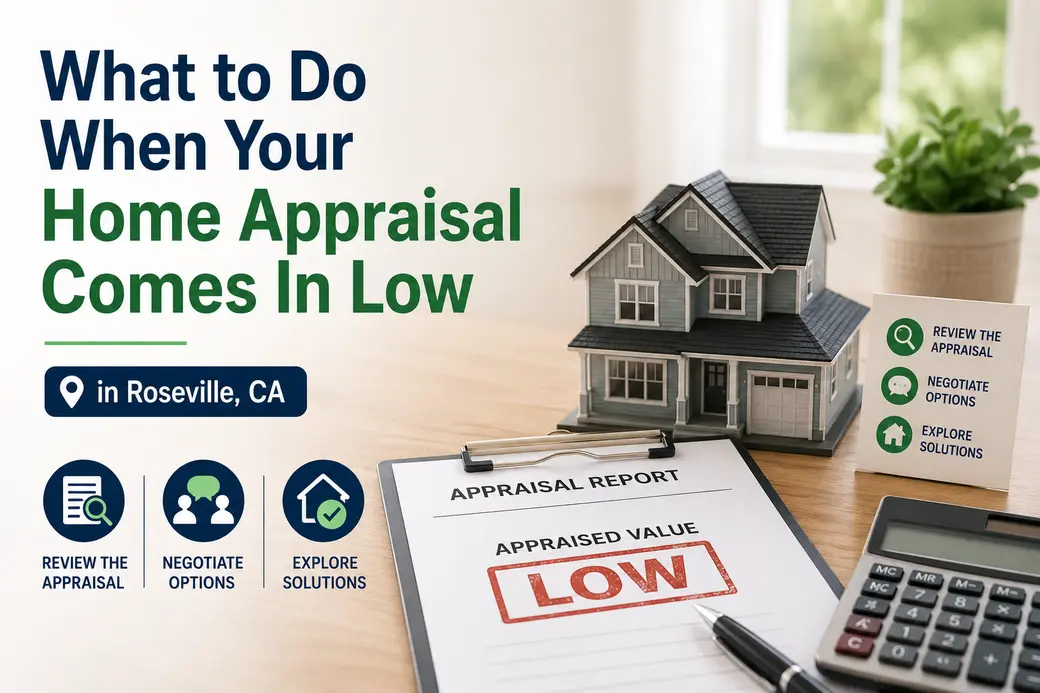
What should I do if my home appraisal comes in low in California?
If your home appraisal comes in below the purchase price in California, you have four main options: renegotiate the price with the seller, cover the gap with cash out of pocket, challenge the appraisal with a formal Reconsideration of Value, or walk away using your appraisal contingency. Which path makes sense depends on how large the gap is, how motivated the seller is, and whether you still have your appraisal contingency in place. In most cases, a good agent can help you recover value — or exit cleanly — without losing your earnest money.
By Rich & Kat Farless | June 21, 2026
You've found the house. Your offer got accepted. Inspections are done. You're 20 days into escrow and everything feels like it's moving — until your lender calls.
The appraisal came in low.
Not by $5,000. By $30,000.
This happens more often than people expect, especially in a market like Roseville and the greater Sacramento area, where prices in certain zip codes have softened while sellers are still anchored to last year's comps. It also comes up regularly in new construction — where builder prices can outpace what appraisers are able to support with comparable sales.
Here's what's actually going on, and what you can do about it.
Why Appraisals Come In Low — And Why It Matters
When you're getting a mortgage, your lender won't fund the loan based on the price you agreed to pay. They'll only lend on the lower of the purchase price or the appraised value.
So if you're buying a home in Roseville's 95747 zip code for $680,000 but the appraiser says it's worth $645,000, your lender is treating $645,000 as the value. If you were putting 10% down, you were counting on a $612,000 loan. Now your lender may only approve $580,500 — and you're suddenly on the hook for an extra $35,000 you weren't planning to bring to closing.
That gap — between what you agreed to pay and what the appraiser says the home is worth — is called an appraisal gap.
In a market where buyers are competing hard and some waived their appraisal contingency, this can get expensive fast. In a more balanced market, like Roseville in mid-2026, you have more options.
Your Four Options When the Appraisal Comes In Low
Option 1: Renegotiate the Purchase Price
This is usually the first move, and in a balanced market, it often works.
You send a formal written request — with the appraisal report attached — asking the seller to reduce the price to the appraised value. The seller now knows their home won't appraise for what they're asking, which means any future buyer with financing is going to hit the same wall. In most cases, it's in their interest to negotiate rather than restart the process with a new buyer.
In Roseville's current market, with homes averaging 31–57 days on market depending on the zip code and builders competing aggressively for buyers, many sellers are willing to meet somewhere in the middle. You may not get the full reduction, but even a split can make the deal work.
Your agent will handle this negotiation. If you're working with Rich & Kat in the Roseville area, we've navigated dozens of these situations — and knowing whether to hold firm or accept a partial credit often comes down to reading the seller's motivation correctly.
Option 2: Cover the Gap in Cash
If you love the home and have the funds, you can choose to pay the difference between the appraised value and the purchase price out of pocket. Your loan stays the same — your lender still only finances up to the appraised value — but you bring extra cash to closing to make up the shortfall.
This is a legitimate choice if you believe the appraisal is wrong and the house is truly worth what you offered. Appraisals aren't perfect. They're a snapshot in time, based on comparable sales that may not reflect the most recent market shifts. If you're buying in a neighborhood with strong fundamentals and limited inventory — like parts of West Roseville or Granite Bay — a low appraisal doesn't necessarily mean you're overpaying.
But you should do the math carefully. You're not just covering the gap — you're deciding whether the home at that price still makes financial sense for you.
Option 3: Challenge the Appraisal with a Reconsideration of Value
You can formally request a Reconsideration of Value (ROV) — a written request submitted through your lender asking the appraiser to review their analysis.
This works best when there's a specific, documentable error: a comparable sale they missed, a recent sale that wasn't included because it happened in the last 90 days, or an upgrade or feature they undervalued. Your agent can help you compile the evidence. We've seen ROVs succeed in Roseville when the appraiser pulled comps from a different neighborhood or missed a kitchen renovation.
It doesn't always work. Appraisers don't change their numbers just because the buyer asked — they need a legitimate reason. But it's a free shot worth taking before you bring more cash to the table.
Option 4: Walk Away Using Your Appraisal Contingency
If you still have your appraisal contingency in place, you have the right to cancel the contract and get your earnest money back if the home doesn't appraise at or above the purchase price.
In California, the standard purchase agreement includes an appraisal contingency by default. The key is that it has to be actively removed in writing — if you haven't signed a Contingency Removal form (CAR Form CR) releasing the appraisal contingency, it's still protecting you. We covered how California's active removal system works in more detail in our post on contingency removal and when your earnest money goes hard.
If the seller won't come down, the appraiser won't budge, and you can't cover the gap, walking away is a clean exit. It's not a failure — it's the contingency doing exactly what it was designed to do.
What If You Waived the Appraisal Contingency?
In a competitive offer situation, some buyers waive the appraisal contingency to make their offer stronger. If you did that, your options narrow significantly.
You can still try to negotiate with the seller, but you've given up your legal right to walk away with your earnest money if they refuse. Covering the gap in cash becomes your primary path forward — or losing your deposit if you cancel.
This is one of the most important reasons to think carefully before waiving any contingency. We talk with every buyer about the risk/reward tradeoff before making that call.
New Construction Appraisals in West Roseville: A Special Case
Low appraisals on new construction come with a different dynamic.
Builders in West Roseville — communities like Amoruso Ranch, Fiddyment Farm, Winding Creek, and Sierra Vista — rarely reduce the base purchase price when an appraisal comes in low. Doing so sets a lower benchmark for every other home they're selling in that same community. It's a business decision that has nothing to do with your situation.
Instead, builders will typically offer alternative forms of relief: credits toward upgrades, closing cost contributions, or a temporary rate buydown funded by the builder. These don't lower the recorded sale price, which protects the builder's comps — but they can meaningfully reduce your monthly payment or your out-of-pocket costs at closing.
You can also submit a Reconsideration of Value for new construction, especially if the appraiser pulled comps from resale homes in older neighborhoods rather than from similar new builds with comparable amenities. New construction appraisers are supposed to account for builder upgrades, warranties, and energy efficiency — if they didn't, that's worth challenging.
For a side-by-side look at how new construction and resale monthly payments actually compare in Roseville, including Mello-Roos and HOA, check out our breakdown here.
What Lenders Actually Do When the Appraisal Comes In Low
Your lender is legally required to share the appraisal report with you. Once you have it, here's how the financing math typically plays out:
If your lender was going to give you a 90% loan-to-value loan and the appraised value is $645,000, your loan is capped at $580,500 — regardless of what you agreed to pay. Your lender can't loan you more than the appraised value allows under their LTV guidelines.
One option: adjust your loan program. Some buyers switch from a conventional loan to an FHA loan or a first-time buyer program that calculates things slightly differently. This won't make the gap disappear, but it might free up cash elsewhere that you can redirect to covering the shortfall. Talk to your lender the same day you get the appraisal results — they'll walk you through what's actually possible.
Internal Timelines: Don't Sit on This
When an appraisal comes in low, the clock is running. Your appraisal contingency has a deadline. Your overall escrow closing date has a deadline. If you're going to renegotiate with the seller, request an ROV, or make a decision about covering the gap, you need to move within days — not weeks.
Your agent should be involved immediately. Get on the phone, review the numbers together, and decide on your strategy before deadlines start closing in on you. If you need a brief escrow extension to complete the negotiation, that needs to be negotiated with the seller in writing before your current closing date, not after.
For a full picture of how the California escrow timeline unfolds, including inspection, contingency removal, and closing steps, our guide on what happens after your offer is accepted in Roseville walks through each stage.
Frequently Asked Questions
Can a seller refuse to negotiate after a low appraisal? Yes. A seller is not legally required to reduce their price because of a low appraisal. However, if you still have your appraisal contingency in place, you can walk away and get your earnest money back if they won't negotiate. In practice, most sellers in a balanced market would rather negotiate than restart the process.
Does a low appraisal mean I'm overpaying for the house? Not necessarily. Appraisals are based on past sales, and they can lag behind in fast-moving or low-inventory neighborhoods. If you believe the home's value will hold or appreciate — and you can afford to cover the gap — paying above appraised value isn't always the wrong call. Talk it through with your agent before deciding.
How long does the appraisal process take in California? A standard appraisal typically takes 7–14 days from when the appraiser inspects the property. Your lender orders it after you're under contract. In Roseville and the Sacramento area, turnaround times can run on the faster end of that range.
What is a Reconsideration of Value? It's a formal written request — submitted through your lender — asking the appraiser to revisit their analysis based on new evidence: missed comparable sales, factual errors, or features they didn't adequately account for. Your agent can help compile the supporting data.
What happens to my earnest money if the appraisal comes in low and I cancel? If your appraisal contingency is still active and you cancel within the contingency period because the home didn't appraise, you get your earnest money back in full. If you've already removed the appraisal contingency in writing, you've waived that protection — and the seller may be entitled to keep your deposit if you cancel.
The Bottom Line
A low appraisal feels like a crisis. It almost never is — but it does require a fast, informed response. You've got options. In most cases, the right combination of negotiation, documentation, and creative financing will get you to the closing table. In the cases where it won't, your contingency is there to protect you.
If you're in escrow right now and your appraisal just came in low — or you're buying in Roseville and want to understand how to structure your offer to protect yourself — let's talk.
Schedule a free consultation with Rich & Kat at richandkatsoldthat.com/talktous
Rich and Kat Farless are a husband-and-wife real estate team with over 30 years of combined experience serving buyers and sellers across the Sacramento region. As the #1 husband-and-wife team in Roseville, CA, they specialize in single family, new construction, and luxury properties across Placer, Sacramento, and El Dorado counties. Connect with them at richandkatsoldthat.com.
Categories
- All Blogs (80)
- Buyer Guides (3)
- Buyers (2)
- Buying a Home (7)
- First-Time Buyers (2)
- Sellers (3)
- Buyer Resources (1)
- buyers (4)
- Buying (4)
- Buying a Home (14)
- Buying a Home, New Construction, Placer County, Roseville (1)
- California Process (1)
- California Real Estate (2)
- California Real Estate Process (10)
- Cost of Buying (2)
- Cost of Homeownership (1)
- Cost to Buy (2)
- Costs & Finances (6)
- El Dorado County (1)
- El Dorado Hills (1)
- Financing & Mortgages (3)
- First-Time Buyers (1)
- Folsom (2)
- Granite Bay (1)
- HOA (1)
- Home Buying (1)
- Home Financing (1)
- Home Prep & Pricing (1)
- Home Selling (3)
- Home Selling Tips (2)
- Lincoln CA (1)
- Loomis (2)
- New Construction (5)
- placer county (1)
- Real Estate Process (1)
- repairs (1)
- Roseville Real Estate (4)
- Seller Costs (2)
- Seller Guides (1)
- Seller Resources (1)
- sellers (3)
- Selling (4)
- selling a home (11)
Recent Posts










Agent License ID: 01193836, 01186753
+1(916) 284-1520 | kat@homesbyrichandkat.com