How Much Income Do You Need to Buy a House in Roseville?
How much money do you need to make to buy a house in Roseville, CA?
To comfortably buy a median-priced home in Roseville — around $635,000 in mid-2026 — you'll generally want a household income between $140,000 and $170,000, assuming roughly 10–20% down and a 30-year rate near 6.5%. But there's no single magic number. The income you actually need swings with your down payment, your other monthly debts, your interest rate, and local costs like property taxes and Mello-Roos. Put more down or carry less debt, and you can qualify on less.
By Rich & Kat Farless | July 23, 2026
It's the first real question almost every buyer asks us: "What do we need to make to afford a home here?" And it's the right question to ask before you fall in love with a house you can't comfortably carry.
The honest answer is that "how much income do you need" depends on more than the price tag. Two families looking at the same $635,000 Roseville home can need very different incomes to qualify — because one has a car payment and student loans, and the other has zero debt and 20% down. So instead of throwing one number at you, let's walk through how lenders actually decide, run a couple of real Roseville examples, and show you the levers that lower the income you need.
The short answer for a median Roseville home
Roseville's median sale price sits around $635,000 in mid-2026, with listing prices hovering near $629,500 as of June. At today's rates — roughly 6.5% on a 30-year fixed — here's the ballpark for a median home with 20% down:
- Loan amount: ~$508,000
- Principal & interest: ~$3,210/month
- Property taxes (about 1.1% effective in Placer County): ~$580/month
- Homeowners insurance: ~$150–$250/month
- Total monthly payment (PITI): roughly $4,000/month
To carry a ~$4,000 payment comfortably — keeping housing near a third of your gross income — you're looking at about $145,000 a year. Want more breathing room and a stricter budget? Closer to $170,000. Willing to stretch your debt-to-income ratio with little other debt? Some buyers qualify closer to $120,000.
That's the range. Now here's why it moves.
How lenders actually decide what you can afford
Lenders don't look at your income in a vacuum. They look at two ratios, often called the 28/36 rule:
- Front-end ratio: your total housing payment should sit around 28% of your gross monthly income.
- Back-end ratio: your housing payment plus all other monthly debts — car loans, credit cards, student loans, personal loans — should stay under about 36%.
Here's the part most buyers don't realize: those are guidelines, not hard walls. With strong credit and reserves, conventional loans often approve back-end ratios up to 43–45%, and FHA loans can stretch to 43% and sometimes 50% with compensating factors. That flexibility is exactly why your other debts matter so much. A $600 car payment can knock tens of thousands off the price you qualify for, because it eats into that back-end ratio dollar for dollar.
This is also why we tell every buyer to get pre-approved before you start touring homes. A pre-approval turns all of this from guesswork into a real number tied to your actual credit, income, and debts — and in a market where well-priced Roseville homes still move, it's what makes your offer credible.
Two real Roseville scenarios
Numbers make this concrete. Both examples use a $635,000 Roseville home at ~6.5%.
Scenario 1 — 20% down ($127,000): Your loan is $508,000, your payment lands near $4,000/month all-in, and you'd comfortably want around $145,000 in household income. This is the cleanest path — no mortgage insurance, the lowest monthly payment, and the most cushion.
Scenario 2 — FHA at 3.5% down ($22,225): Now you're financing about $612,775. Add FHA mortgage insurance, and your payment climbs to roughly $4,900/month. Comfortably, that points to a higher income — but because FHA allows more generous debt ratios, buyers with minimal other debt often still qualify in the $120,000–$140,000 range. The tradeoff is clear: a smaller down payment gets you in the door with less cash, but the monthly payment — and the income to support it — goes up.
Notice what's happening. Less money down doesn't lower the income you need — it usually raises it, because you're borrowing more and adding insurance. The down payment and the income requirement pull in opposite directions, and the right balance depends entirely on your savings and your monthly comfort level.
The local costs that change your number
Roseville has a few wrinkles that national affordability calculators miss:
- Mello-Roos. Many newer West Roseville communities — think Fiddyment Farm, Amoruso Ranch, and Winding Creek — carry Mello-Roos assessments that can add $150–$300+ a month. That's income you need on top of the base payment. Established resale neighborhoods across Roseville often carry little or none. If you're weighing new construction, our guide to what your monthly payment actually looks like on new construction vs. resale breaks this down.
- HOA dues. Where they apply, they're counted in your debt-to-income ratio just like a car payment.
- Homeowners insurance. California's insurance market has tightened, and premiums have climbed — a real line item to budget, especially in the foothill communities.
- Cash beyond the down payment. You'll also need closing costs, which typically run 2–4% of the price. Our breakdown of buyer closing costs in Roseville shows where that money goes.
What it takes across the region
Roseville isn't the only market we serve, and the income you need shifts with the price point. Here's a rough guide — all assuming 20% down, ~6.5%, and housing near a third of gross income:
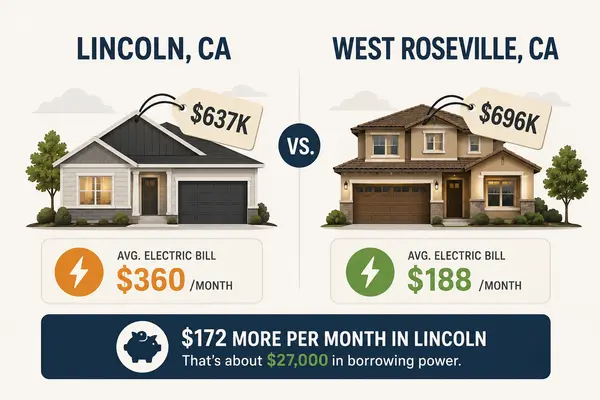
- Lincoln (~$628K median): ~$143,000
- Roseville (~$635K median): ~$145,000
- Folsom (~$770K median): ~$175,000
- El Dorado Hills (~$866K median): ~$198,000
- Granite Bay (~$1.25M median): ~$290,000 (and likely a jumbo loan)
These are estimates, not quotes — your real number depends on your down payment, debts, and the specific home's taxes and dues. But they show the shape of the regional market: you can find a starting point in Lincoln or parts of Roseville for meaningfully less income than the foothill luxury markets require.
How to lower the income you need
If the numbers feel out of reach, you have more levers than you'd think:
- Put more down. A bigger down payment shrinks the loan, drops the payment, and lowers the income to qualify.
- Pay down debt first. Clearing a car loan or credit card balance can free up thousands in buying power by improving your back-end ratio.
- Buy down the rate. A seller-paid or lender-paid rate buydown can lower your monthly payment meaningfully — sometimes worth negotiating right into your offer.
- Explore down payment assistance. Programs come and go, so it's worth checking what's currently available to Placer County buyers.
- Choose a home with lower carrying costs. A resale home with no Mello-Roos and no HOA can require noticeably less income than a new build at the same price.
The truth is, "how much do I need to make" is really the start of a bigger conversation about down payment, debt, and the kind of home that fits your life. That's exactly the conversation we walk buyers through before they ever write an offer — and the only way to get your number instead of a rule of thumb is to run it with a lender and an agent who know this market.
Frequently Asked Questions
What salary do I need to buy a $600,000 house in Roseville?
On a $600,000 home with 20% down at about 6.5%, your all-in payment lands near $3,800/month, pointing to roughly $135,000–$140,000 in household income to carry it comfortably. With less down or more debt, you'd want more; with a larger down payment or zero other debt, you could qualify on less.
Do I need to make six figures to buy a home in Placer County?
For a median-priced home in Roseville, Lincoln, or most of Placer County, yes — most buyers need a household income comfortably into the $130,000s or higher at today's prices and rates. Lower-priced homes and larger down payments can bring that down, and combining incomes on a joint application is common here.
How much house can I afford on $150,000 a year?
At $150,000 in household income with modest debt and 20% down, most buyers can comfortably afford a home in the $620,000–$680,000 range at current rates — right around Roseville's median. Your exact number depends on your debts, credit, and down payment, which is why a pre-approval is the real answer.
Does a bigger down payment lower the income I need?
Yes. A larger down payment means a smaller loan and a lower monthly payment, which reduces the income required to qualify. It also helps you avoid mortgage insurance once you hit 20% down on a conventional loan, lowering your payment further.
What counts against me when a lender calculates affordability?
Your monthly debts — car payments, credit cards, student loans, and personal loans — all count in your debt-to-income ratio and reduce how much home you can afford. Property taxes, HOA dues, Mello-Roos assessments, and homeowners insurance also get factored into the payment lenders qualify you against.
Buying in Roseville comes down to a simple pairing: the price of the home and the income and cash to carry it comfortably. Get those two lined up, and everything else in the transaction gets easier. If you're ready to figure out your real number — what you qualify for, what you'll pay monthly, and what it takes to get there — Rich & Kat are here to help. Schedule a free consultation at richandkatsoldthat.com/talktous.
About Rich & Kat Farless Rich and Kat Farless are a husband-and-wife real estate team with over 30 years of combined experience serving buyers and sellers across the Sacramento region. As the #1 husband-and-wife team in Roseville, CA, they specialize in single family, new construction, and luxury properties across Placer, Sacramento, and El Dorado counties. Connect with them at richandkatsoldthat.com.
Categories
- All Blogs (76)
- Buyer Guides (2)
- Buyers (1)
- Buying a Home (6)
- First-Time Buyers (2)
- Sellers (2)
- Buyer Resources (1)
- buyers (4)
- Buying (4)
- Buying a Home (14)
- Buying a Home, New Construction, Placer County, Roseville (1)
- California Process (1)
- California Real Estate (2)
- California Real Estate Process (10)
- Cost of Buying (2)
- Cost of Homeownership (1)
- Cost to Buy (2)
- Costs & Finances (6)
- El Dorado County (1)
- El Dorado Hills (1)
- Financing & Mortgages (3)
- First-Time Buyers (1)
- Folsom (2)
- Granite Bay (1)
- HOA (1)
- Home Buying (1)
- Home Financing (1)
- Home Prep & Pricing (1)
- Home Selling (3)
- Home Selling Tips (2)
- Lincoln CA (1)
- Loomis (2)
- New Construction (5)
- placer county (1)
- Real Estate Process (1)
- repairs (1)
- Roseville Real Estate (4)
- Seller Costs (2)
- Seller Guides (1)
- Seller Resources (1)
- sellers (3)
- Selling (4)
- selling a home (11)
Recent Posts









Agent License ID: 01193836, 01186753
+1(916) 284-1520 | kat@homesbyrichandkat.com