What Do California Sellers Have to Disclose When Selling a Home?

What Do California Sellers Have to Disclose When Selling a Home?
California law requires sellers of residential property to complete three core disclosure forms before closing: the Transfer Disclosure Statement (TDS), the Seller Property Questionnaire (SPQ), and a Natural Hazard Disclosure (NHD) report. Beyond those forms, you're required to disclose any known material fact that could affect the value or desirability of your home — including structural issues, water damage, unpermitted work, mold, and past insurance claims. Selling "as-is" does not exempt you from these requirements. In Roseville and Placer County, local factors like Mello-Roos assessments, HOA documents, dam inundation zones, and wildfire hazard designations add additional layers sellers need to address.
By Rich & Kat Farless | June 20, 2026
If you're getting ready to sell your home in Roseville, one of the first questions that comes up is: What exactly am I required to tell a buyer?
It's a fair question — and a stressful one for many sellers. California has some of the most comprehensive disclosure requirements in the country. Getting them right protects you from post-close lawsuits. Getting them wrong can cost you the deal, expose you to legal liability, or result in a buyer walking away right before closing.
Here's what every seller in Roseville, Granite Bay, Folsom, Lincoln, and the greater Placer County area needs to know.
The Three Core Disclosure Forms Every California Seller Must Complete
California requires sellers of one-to-four-unit residential property to deliver three foundational documents to the buyer — typically within seven days of an accepted offer.
1. The Transfer Disclosure Statement (TDS)
The TDS is the cornerstone of California seller disclosure. It's a standardized form (governed by California Civil Code §1102–1102.14) that requires you to document the condition of your home across dozens of categories: roof, foundation, plumbing, electrical, HVAC, appliances, room additions, permits, flooding history, drainage issues, neighborhood nuisances, and more.
You're not expected to be a home inspector — you're expected to report what you know. If you've had a roof leak, experienced foundation settling, noticed a plumbing backup, or had a pest infestation treated, those go on the TDS. Your agent also completes a section of the TDS, and the buyer's agent may add observations as well.
The TDS is not a warranty. You're not guaranteeing the condition of the home. But you are certifying that you've disclosed everything material that you're aware of.
2. The Seller Property Questionnaire (SPQ)
The SPQ goes deeper than the TDS. It's a supplemental C.A.R. form that asks detailed questions about your property's history — repairs made, improvements completed, insurance claims filed, whether there's been any mold, flooding, fire, smoke, or odor issues, whether there are any encroachments or easements, disputes with neighbors, litigation history, and more.
Think of the TDS as a snapshot of the home's current condition, and the SPQ as a timeline of its history. Together, they give the buyer a complete picture.
Common SPQ disclosures that trip up Roseville sellers:
- Unpermitted work — a garage conversion, a room addition, a deck built without permits. These must be disclosed even if the work was done by a previous owner.
- Past insurance claims — a roof replaced after a windstorm, a water loss claim. If it happened on your watch, it goes on the SPQ.
- Neighbor disputes — a fence line disagreement, a shared driveway issue. Even informal disputes belong here.
- HOA violations — if you've received any notices from your HOA, disclose them.
3. The Natural Hazard Disclosure (NHD) Report
The NHD report is ordered through a third-party NHD company — not filled out by the seller — and it maps your property against six state-designated hazard zones: special flood hazard areas, dam inundation areas, very high fire severity zones, wildland fire risk zones, earthquake fault zones, and seismic hazard zones (landslide and liquefaction).
In Roseville and Placer County, this matters more than many sellers realize:
- Dam inundation: Much of Roseville falls within the theoretical inundation zone below Folsom Dam. This will appear on your NHD report. Buyers see it — and your agent needs to be prepared to explain what it means (and doesn't mean) in practice.
- Wildfire zones: Parts of eastern Roseville, Granite Bay, Folsom, Lincoln, and Loomis fall in or near Very High Fire Hazard Severity Zones. If your property is in one of these zones, it triggers mandatory defensible space requirements and may affect your buyer's homeowner's insurance costs.
- Flood zones: Properties near Dry Creek and its tributaries in Roseville may fall in a FEMA Special Flood Hazard Area (SFHA), which can require flood insurance.
The NHD report is non-negotiable. California law prohibits you from selling a home without one.
What "Known Material Defects" Means — And Why "As-Is" Doesn't Get You Off the Hook
Here's where sellers often get confused: you can absolutely sell your home in "as-is" condition in California. Plenty of sellers do. But "as-is" means you're not going to fix anything — it doesn't mean you don't have to disclose anything.
California law imposes what's called the "affirmative duty to disclose." Any fact that materially affects the value or desirability of your home — and that a buyer couldn't easily discover through their own inspection — must be disclosed. The standard is good faith: disclose what you know.
Common examples of required disclosures sellers sometimes think they can skip:
- Water damage, past or repaired. Even if you fixed a roof leak five years ago and replaced the drywall, that history must be disclosed. A buyer has a right to know the property had water intrusion.
- Mold. If you discovered mold and remediated it, disclose the mold and the remediation. Buyers should know and can verify the work was done correctly.
- Deaths on the property. California law requires disclosure of any death that occurred on the property within the last three years. The exception: deaths related to HIV/AIDS are not required to be disclosed under California Health & Safety Code §1710.2.
- Neighbor issues and noise. A barking dog next door, a neighbor who plays music late, a commercial property that generates trucks at 5 a.m. — these are legitimate disclosure items.
- Material defects repaired by prior owners. If you know about it, disclose it — even if it happened before you owned the home.
- Tobacco or nicotine use inside the home. As of 2026, California sellers must disclose known tobacco or nicotine use inside the property.
- Lead-based paint. If your home was built before 1978, federal law requires a Lead-Based Paint Disclosure. Violations carry penalties up to $19,507 per violation.
The bottom line: if you're asking yourself "should I disclose this?" — the answer is almost certainly yes. It costs you nothing to disclose and it protects you from a lawsuit after closing.
Roseville and Placer County: Local Disclosures That Can Catch Sellers Off Guard
In addition to the statewide requirements, Roseville and Placer County sellers have some local-specific disclosures to address.
Mello-Roos / CFD Assessments
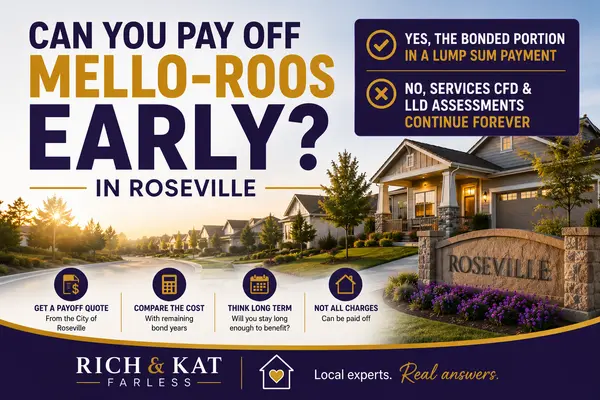
If your home is in a Community Facilities District (CFD) — which is common in West Roseville, Fiddyment Farm, Winding Creek, Amoruso Ranch, and many newer subdivisions — you're required to disclose the CFD and the annual assessment amount. Buyers have a right to understand the full cost of ownership, and Mello-Roos can add $2,000–$5,000+ per year to a tax bill.
If you're unsure whether your home is in a CFD, check your property tax bill — CFD charges appear as a separate line item. Your agent can also help you verify this through the Placer County Assessor's office.
HOA Documents
If your home is subject to a homeowners' association, California law requires you to provide the buyer with a full HOA document package: the CC&Rs, bylaws, current budget, reserve study, meeting minutes from the past 12 months, any pending special assessments, and any litigation involving the HOA. Most HOAs charge a transfer fee ($200–$500 is typical) to prepare and deliver this package, and it can take up to 10 business days — so order it early.
Airport Influence Areas
Homes near Sacramento Executive Airport or under certain flight paths may fall in an Airport Influence Area (AIA), which must be disclosed. This is more relevant for properties in certain parts of Sacramento County but can affect some Roseville-area properties depending on proximity.
Timelines, Delivery Rules, and Your Liability After Closing
Under the California Residential Purchase Agreement (RPA), you have seven calendar days from contract acceptance to deliver the TDS, SPQ, and NHD report to the buyer. Missing this deadline gives the buyer additional rights — including the right to extend their contingency periods or, in some cases, cancel the transaction.
Once the buyer receives the TDS, they have a statutory cancellation window: three days if delivered in person, five days if delivered by mail. Your agent should confirm receipt and start the clock.
After closing, California courts have found sellers liable for disclosure failures even years later — if the defect couldn't reasonably have been discovered earlier. This is why your goal isn't just to fill out the forms — it's to fill them out completely and accurately.
Your agent plays an important role here. A good listing agent in Roseville will walk through your home, review your disclosure forms with you, flag anything that might be missing, and help you present known issues accurately. They also complete their section of the TDS, which adds another layer of documentation.
If you're unsure whether something rises to the level of "material" — ask your agent. The cost of disclosure is zero. The cost of a post-close lawsuit is not.
FAQ
Do I have to disclose if a death occurred on my property in California?
Yes, if the death occurred within the last three years. California Civil Code §1710.2 requires disclosure of deaths on the property within the past three years, with one exception: deaths related to HIV/AIDS are specifically exempt from disclosure. If a death occurred more than three years ago and you're not required to disclose it, a buyer may still ask directly — and you may choose to answer.
What if I genuinely didn't know about a defect — am I still liable?
The TDS and SPQ require you to disclose what you know. If you genuinely were unaware of a defect, you're not expected to disclose something you couldn't have known. However, courts distinguish between "didn't know" and "should have known." If a defect was visible or reasonably discoverable, "I didn't look" generally doesn't protect you. Complete the forms honestly based on your actual knowledge of the home.
What's the difference between the TDS and the SPQ?
The TDS is a standardized state form that covers current property condition across a wide range of categories. The SPQ is a supplemental C.A.R. form that focuses on the property's history — past repairs, insurance claims, legal disputes, and other events during your ownership. Both are required for most California residential transactions. You'll fill them out separately, but they're delivered to the buyer together as part of the disclosure package.
Do I still have to complete the TDS if I'm selling "as-is"?
Yes. "As-is" means you're not agreeing to make repairs — it doesn't affect your disclosure obligations. California Civil Code requires the TDS regardless of whether a sale is being made "as-is," in probate, by a trustee, or under any other arrangement. The only categories of sellers who are exempt from the TDS are specific statutory exemptions (court-ordered sales, some trustee sales, etc.) — and standard residential sales don't qualify for those exemptions.
What happens if I forget to disclose something important?
If you omit a known material fact and the buyer discovers it after closing, you can face a lawsuit for fraudulent concealment, negligent misrepresentation, or breach of disclosure obligations. California courts have allowed buyers to rescind a sale (undo the transaction) or recover damages, including the cost of repairs, diminution in property value, and attorney's fees. The statute of limitations varies, but in some cases buyers have successfully sued sellers years after closing when the defect wasn't reasonably discoverable earlier.
Ready to Sell Your Roseville Home with Confidence?
California seller disclosures can feel overwhelming — but they don't have to be. When you work with Rich & Kat Farless, we walk through every disclosure form with you, help you identify anything you may have missed, and present your home's history accurately and professionally. Our goal is to protect you before, during, and after the sale.
Schedule a free consultation at richandkatsoldthat.com/talktous and let's talk about selling your Roseville-area home the right way.
Rich and Kat Farless are a husband-and-wife real estate team with over 30 years of combined experience serving buyers and sellers across the Sacramento region. As the #1 husband-and-wife team in Roseville, CA, they specialize in single family, new construction, and luxury properties across Placer, Sacramento, and El Dorado counties. Connect with them at richandkatsoldthat.com.
Related reading:
Categories
- All Blogs (78)
- Buyer Guides (3)
- Buyers (1)
- Buying a Home (7)
- First-Time Buyers (2)
- Sellers (2)
- Buyer Resources (1)
- buyers (4)
- Buying (4)
- Buying a Home (14)
- Buying a Home, New Construction, Placer County, Roseville (1)
- California Process (1)
- California Real Estate (2)
- California Real Estate Process (10)
- Cost of Buying (2)
- Cost of Homeownership (1)
- Cost to Buy (2)
- Costs & Finances (6)
- El Dorado County (1)
- El Dorado Hills (1)
- Financing & Mortgages (3)
- First-Time Buyers (1)
- Folsom (2)
- Granite Bay (1)
- HOA (1)
- Home Buying (1)
- Home Financing (1)
- Home Prep & Pricing (1)
- Home Selling (3)
- Home Selling Tips (2)
- Lincoln CA (1)
- Loomis (2)
- New Construction (5)
- placer county (1)
- Real Estate Process (1)
- repairs (1)
- Roseville Real Estate (4)
- Seller Costs (2)
- Seller Guides (1)
- Seller Resources (1)
- sellers (3)
- Selling (4)
- selling a home (11)
Recent Posts









Agent License ID: 01193836, 01186753
+1(916) 284-1520 | kat@homesbyrichandkat.com