Homeowners Insurance in Roseville, CA: What Buyers Need to Know in 2026
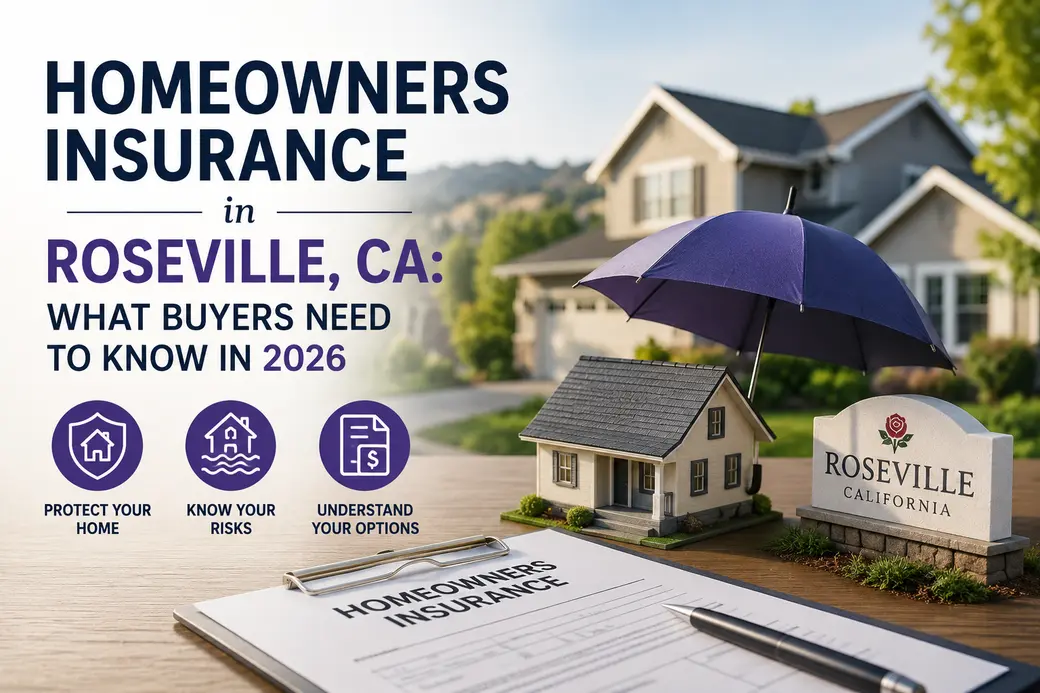
What Do Roseville Buyers Need to Know About Homeowners Insurance in 2026?
Getting homeowners insurance in California has become one of the most stressful — and sometimes deal-derailing — parts of buying a home, especially in West Roseville and other fast-growing Placer County communities. Mortgage lenders require proof of insurance before they'll fund your loan, which means you must secure coverage before you can close. California's ongoing insurance crisis has shrunk available carriers, pushed many buyers toward the California FAIR Plan (the state's insurer of last resort), and driven premiums up dramatically — with another 29% FAIR Plan rate hike scheduled for October 2026.
By Rich & Kat Farless | June 24, 2026
When most buyers come to us ready to make an offer in West Roseville or Granite Bay, they're thinking about the purchase price, the Mello-Roos, and the monthly payment. Insurance is usually an afterthought — something to handle a few weeks before closing.
That's changed. Dramatically.
Over the past few years, California's homeowners insurance market has undergone a crisis that's directly affecting buyers in our market. More than 400,000 homeowners insurance policies have been canceled across the state since 2021. Fifteen or more major carriers have stopped writing new policies in California. The California FAIR Plan — the backstop insurer that steps in when private carriers won't — has grown from covering 1.5% of California single-family homes in late 2020 to 5% today, with enrollment up 43% in just 15 months.
And in certain ZIP codes — including 95747 in West Roseville — private carriers have been hitting their concentration limits, meaning they stop writing new policies in that area even when they'd otherwise qualify the buyer.
This isn't a distant problem. It's happening in your backyard, and you need to account for it before you're three weeks from closing.
Why Homeowners Insurance Matters at Closing
Your mortgage lender will not fund your loan without proof of homeowners insurance — specifically, a policy that provides at least dwelling coverage for your home's replacement cost. This isn't optional, and it isn't something you can sort out after closing.
The process works like this: during escrow, your lender's underwriting team will ask for proof of insurance — typically a declarations page or a binder from your insurer. If you can't produce it, closing gets delayed. If you can't find coverage at all, the deal may fall apart.
In a normal California market, shopping for insurance takes a couple of phone calls. In 2026, it can take several weeks — sometimes longer — especially if you're buying in West Roseville, near a wildfire hazard zone, or in an area where multiple carriers have already hit their concentration limits.
Start shopping for insurance as soon as you're in contract. Don't wait for the inspection or appraisal to wrap up. By the time you're removing contingencies, you should already know what your insurance options look like. We always remind our buyers of this on day one of escrow — and in today's market, that head start matters.
If you're calculating your total monthly payment on a new construction home in Roseville, insurance needs to be in that number — not estimated, but actually quoted.
The California FAIR Plan: What It Is and What It Costs
If private carriers won't write a policy on your home, you'll likely turn to the California FAIR Plan. Here's what you need to understand before you treat it as a simple backup.
The FAIR Plan is not a full homeowners policy. It was created specifically to provide fire insurance when private market insurers won't. The base FAIR Plan covers fire, smoke, and internal explosion. It does not cover water damage, liability, theft, or several other standard perils you'd expect from a normal homeowners policy.
You'll almost certainly need a DIC policy alongside it. A DIC (Difference in Conditions) policy fills the gaps the FAIR Plan doesn't cover. In 2026, most buyers who end up on the FAIR Plan pair it with a DIC wrap to get something approaching full coverage. The combined premium for a FAIR Plan + DIC structure in Roseville typically runs $3,000–$6,000 per year or more, depending on your home's replacement cost and the specific carrier options available in your ZIP code.
FAIR Plan rates are rising again. Starting October 15, 2026, the California FAIR Plan will increase rates by an average of 29.8% statewide. If you're already on the plan — or planning to land on it — factor this into your budget.
FAIR Plan premiums vary widely by location. Statewide, FAIR Plan policies range from under $1,000 per year to over $32,000, depending on the property's location, wildfire risk, and replacement cost. The same house a mile apart can land in very different rate tiers based on fire hazard severity zone classifications.
If you're buying in West Roseville — particularly in Winding Creek, Amoruso Ranch, Sierra Vista, or Fiddyment Farm — ask your real estate agent and your insurance broker about what coverage actually looks like in that specific ZIP code before you go deep into contract. This is a conversation that belongs early, not at the end of escrow.
How to Shop for Homeowners Insurance as a Roseville Buyer
The process of finding insurance has shifted from a quick comparison to a more methodical search. Here's how to approach it.
Start early. Ideally, get your insurance conversation going within the first week of being in contract — not in the final days before closing. Early outreach to an insurance broker gives you time to explore alternatives if your first choice falls through. If you're buying a home covered by a seller disclosure that flags a wildfire hazard zone or State Responsibility Area, that's your cue to start immediately.
Work with an independent broker, not a captive agent. A captive agent can only offer you one company's products. An independent broker shops across dozens of carriers and can give you a realistic read on what's actually available at your address. In today's California market, this distinction is enormous.
Ask your builder if they have preferred insurance partners. If you're buying a new construction home in West Roseville or elsewhere in Placer County, your builder may have relationships with insurers actively writing policies in those specific communities. It's not always the best price, but it's worth asking — and worth comparing.
Know your Natural Hazard Disclosure. California requires sellers to provide a Natural Hazard Disclosure (NHD) report showing whether the property falls within a fire hazard severity zone, a State Responsibility Area, or other designated hazard areas. You'll receive this as part of your seller disclosures during escrow. Properties in higher-risk zones face more limited private market options and often higher premiums. If you see a Wildland-Urban Interface (WUI) designation, start your insurance search immediately.
Budget for the real number, not the optimistic one. We're seeing buyers budget $100–$150/month for homeowners insurance based on what they paid in another state or heard from friends a few years ago. In West Roseville in 2026, a new construction home valued at $700,000–$900,000 might run $2,500–$5,000 per year in insurance depending on coverage level and carrier options — that's $208–$417/month. That's a meaningful difference in how your closing costs and prepaid expenses add up, and in how your monthly payment actually lands.
Your lender will collect 2–3 months of insurance premiums at closing as part of your prepaid escrow, so your upfront costs are affected too. Get real quotes before you finalize your numbers.
What Happens If You Can't Find Coverage?
A few scenarios worth knowing about:
If you can't find private market coverage and need to go through the California FAIR Plan, your lender will typically accept it as long as it meets their minimum dwelling coverage requirements. Most do — though you'll want to confirm with your specific loan officer early.
If you can't find any coverage at all (extremely rare, but possible in very high-risk zones), your lender may resort to force-placed insurance — coverage they obtain on your behalf, at your expense, typically at a significantly higher premium and with much less coverage. This is the worst-case scenario, and it reinforces why you start shopping early.
New construction developers in West Roseville have started adding disclosures to purchase agreements acknowledging that they cannot guarantee insurance availability for all homes. If you see this language in your new construction contract, don't ignore it — it's your signal to make insurance a priority, not an afterthought.
Frequently Asked Questions
Is homeowners insurance required when buying a home in California?
California law does not require homeowners to purchase insurance — but your mortgage lender absolutely does. Lenders require proof of coverage before they'll fund your loan, and most require at minimum a dwelling coverage policy that covers the home's replacement cost. Without it, you cannot close.
What is the California FAIR Plan and when would I need it?
The California FAIR Plan is the state's insurer of last resort — a fire insurance backstop for homeowners who cannot obtain coverage through the private market. If carriers decline to write a policy at your address, you can apply through the FAIR Plan. It covers fire, smoke, and internal explosion, but leaves significant gaps in coverage. Most buyers pair it with a DIC (Difference in Conditions) policy to get broader protection.
How much does homeowners insurance cost for a new home in West Roseville in 2026?
It varies significantly based on the specific property, ZIP code, construction type, replacement cost, and which carriers are actively writing policies at that address. A rough planning budget for a new construction home in the $700K–$900K range in West Roseville runs $2,500–$5,000 per year combined — more if you're on a FAIR Plan + DIC structure. Get real quotes from an independent broker early in your escrow, not at the end.
Will the California FAIR Plan satisfy my mortgage lender's insurance requirements?
Yes — a California FAIR Plan fire policy typically satisfies lenders' minimum insurance requirements, though you should confirm with your specific loan officer. Lenders look for dwelling coverage at replacement cost, and the FAIR Plan's fire coverage generally qualifies. You'll still want to add a DIC policy for your own protection, but that's separate from what the lender technically requires.
Does buying in West Roseville mean I'll definitely end up on the FAIR Plan?
Not necessarily. The situation is fluid and varies by the specific community, builder, and the carrier market at the time you're closing. Some buyers in West Roseville still qualify for private market coverage. Others land on the FAIR Plan immediately. The only way to know is to get real quotes from an independent broker for your specific address as soon as you're in contract.
Insurance is no longer a closing-week task in Roseville. In the fast-growing new construction communities of West Roseville especially, it's part of the financial due diligence that belongs in the first week of escrow — not the last.
If you want to know what the real total monthly cost of ownership looks like — insurance, Mello-Roos, HOA, property taxes, and all — that's exactly the conversation we walk our clients through before they make an offer.
Schedule a free consultation at richandkatsoldthat.com/talktous and let's talk through your specific situation.
About Rich & Kat Farless Rich and Kat Farless are a husband-and-wife real estate team with over 30 years of combined experience serving buyers and sellers across the Sacramento region. As the #1 husband-and-wife team in Roseville, CA, they specialize in single family, new construction, and luxury properties across Placer, Sacramento, and El Dorado counties. Connect with them at richandkatsoldthat.com.
Categories
- All Blogs (84)
- Buyer Guides (3)
- Buyers (2)
- Buying a Home (7)
- First-Time Buyers (2)
- Loomis (1)
- Sellers (4)
- Buyer Resources (1)
- buyers (4)
- Buying (4)
- Buying a Home (14)
- Buying a Home, New Construction, Placer County, Roseville (1)
- California Process (1)
- California Real Estate (2)
- California Real Estate Process (11)
- Cost of Buying (2)
- Cost of Homeownership (1)
- Cost to Buy (2)
- Costs & Finances (6)
- El Dorado County (1)
- El Dorado Hills (1)
- Financing & Mortgages (3)
- First-Time Buyers (1)
- Folsom (2)
- Granite Bay (1)
- HOA (1)
- Home Buying (1)
- Home Financing (1)
- Home Prep & Pricing (1)
- Home Selling (3)
- Home Selling Tips (2)
- Lincoln CA (2)
- Loomis (2)
- New Construction (5)
- placer county (1)
- Real Estate Process (1)
- repairs (1)
- Roseville Real Estate (4)
- Seller Costs (2)
- Seller Guides (1)
- Seller Resources (1)
- sellers (3)
- Selling (4)
- selling a home (11)
Recent Posts








Agent License ID: 01193836, 01186753
+1(916) 284-1520 | kat@homesbyrichandkat.com